

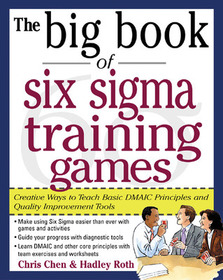
The Big Book of Six Sigma Training Games: Proven Ways to Teach Basic DMAIC Principles and Quality Improvement Tools
Creative Ways to Teach Basic DMAIC Principles and Quality Improvement Tools
Series: Big Book Series;
- Publisher's listprice GBP 25.99
-
12 416 Ft (11 825 Ft + 5% VAT)
The price is estimated because at the time of ordering we do not know what conversion rates will apply to HUF / product currency when the book arrives. In case HUF is weaker, the price increases slightly, in case HUF is stronger, the price goes lower slightly.
- Discount 10% (cc. 1 242 Ft off)
- Discounted price 11 175 Ft (10 643 Ft + 5% VAT)
Subcribe now and take benefit of a favourable price.
Subscribe
12 416 Ft

Availability
printed on demand
Why don't you give exact delivery time?
Delivery time is estimated on our previous experiences. We give estimations only, because we order from outside Hungary, and the delivery time mainly depends on how quickly the publisher supplies the book. Faster or slower deliveries both happen, but we do our best to supply as quickly as possible.
Product details:
- Publisher McGraw Hill
- Date of Publication 16 January 2005
- ISBN 9780071443852
- Binding Paperback
- No. of pages256 pages
- Size 233x185x16 mm
- Weight 444 g
- Language English 0
Categories
Short description:
The quickest, easiest and most enjoyable way to get employees on track with Six Sigma concepts and tools
Each year Six Sigma methods save companies like Motorola, GE, Sony, and Microsoft billions that would have been lost to inefficiency in business processes. But learning Six Sigma methods can be a confusing experience, especially for people without a technical background. In this book, experienced Six Sigma trainer Chris Chen and Six Sigma Master Black Belt Hadley Roth take a proven, innovative approach to getting people from all experiential levels quickly up and running with basic Six Sigma concepts and tools.
The latest in the hugely popular Big Book of Games series, The Big Book of Six Sigma Training Games features 50 games, exercises and activities that provide an enjoyable, non-intimidating way to:
- Acquaint employees with Six Sigma--what it is, where it came from and what it can do for them and their companies
- Teach Six Sigma roles and organization
- Familiarize teams with DMAIC, as well as Failure Mode Effects Analysis, Pareto charts and other key improvement tools
- Gear teams up for success
- Help them identify problems in business processes and generate innovative solutions
All of the activities can be performed using common, everyday materials--such as playing cards, water, and paper clips--and each provides a thorough and enjoyable Six Sigma learning experience.
MoreLong description:
An effective and engaging way employees can learn Six Sigma and put its concepts into play
Part of the popular Big Book of Games series, which capitalizes on the proven effective method for workplace training, this first book of training games for Six Sigma ensures that employees will better retain Six Sigma's complex topics.
This invaluable tool offers 50 experiential activities that teach the core improvement approach of Six Sigma, called DMAIC (Define, Measure, Analyze, Improve, Control), as well as many of the popular statistical improvement tools, including Pareto charts and Failure Mode Effects Analysis (FMEA).
An effective and engaging way employees can learn Six Sigma and put its concepts into play
Part of the popular Big Book of Games series, which capitalizes on the proven effective method for workplace training, this first book of training games for Six Sigma ensures that employees will better retain Six Sigma's complex topics.
This invaluable tool offers 50 experiential activities that teach the core improvement approach of Six Sigma, called DMAIC (Define, Measure, Analyze, Improve, Control), as well as many of the popular statistical improvement tools, including Pareto charts and Failure Mode Effects Analysis (FMEA).
MoreTable of Contents:
Introduction
Chapter 1 Why Six Sigma? Process Improvement Basics
What Is a Process? Process Simulations
Exercise 1-1 Scrambled Letters (A Process Overview)
What Is a Product? Value Propositions
Exercise 1-2 Group Bid (Customer Value)
Exercise 1-3 Vacation Planning (Exploring Value Propositions)
What Is a Quality Product? Focusing on Customer Needs
Exercise 1-4 Customer Landscapes at Affordable Prices (Identifying the Process)
Why Is Each Product Slightly Different? Demonstrating Process Variation
Exercise 1-5 Eyedropper (Examining Process Variation)
Chapter 2 Who’s on First? Roles and Organization
Team Roles
Exercise 2-1 Give–Get (Six Sigma Roles and Expectations)
Exercise 2-2 Lights, Camera, Action (Dealing with Difficult Situations)
Leadership
Exercise 2-3 Team Poker (Leadership and Decision Making)
Exercise 2-4 Historical Leaders (Urgency, Vision, and Message)
Facilitation and Mentoring
Exercise 2-5 Meeting Facilitation (Role Play)
Exercise 2-6 10 Things I Do for Fun (Team Icebreaker)
Chapter 3 What Is Our Quest? The Define Phase
What Hurts? Formulating Problem and Goal Statements
Exercise 3-1 Doctor, Doctor (Stating the Problem and Goal)
Why Do We Need to “Get Better”? Stating the Business Case for Change
Exercise 3-2 Precision Delivery Inc. (Stating the Business Case for Improvement)
Where Will We Improve? Project Scope
Exercise 3-3 Break It Down (Individual Process Map)
Exercise 3-4 World Hunger (Creating Scope Statements)
What Would Be Better? Translating Customer Needs
Exercise 3-5 Dream Car (Finding CTQ Measures)
Chapter 4 How Is the Current Process Performing? The Measure Phase
What Should We Measure? Asking Questions and Testing Theories
Exercise 4-1 Unscrambling the Federal Reserve (Collecting and Organizing Data)
Exercise 4-2 Who’s Here? (Collecting and Displaying Data)
Do We Need to Measure Everything? Working with Samples
Exercise 4-3 Precision Delivery Inc. (Data Collection and Sampling)
Are We Speaking the Same Language? Operational Definitions
Exercise 4-4 Super-Fine Peanuts (Applying Operational Definitions)
Are the Measurements Reliable? Verifying Measurement Systems
Exercise 4-5 Object of the Game (Assessing the Measurement System)
How Good Is My Product? Measuring Process Sigma
Exercise 4-6 Scrambled Letters (Measuring Process Sigma)
Chapter 5 What Are the “Deep Dive” Causes of a Problem? The Analyze Phase
What Might Cause the Problem? Developing Theories
Exercise 5-1 Scrambled Letters (Developing Theories)
How Does the Process Work? Process Mapping
Exercise 5-2 Custom Landscapes at Affordable Prices (Process Analysis)
How Do We Verify Causes? Putting Data to Work
Exercise 5-3 Precision Delivery Inc. (Data Analysis)
Exercise 5-4 Precision Delivery Inc. (Design of Experiment)
Chapter 6 What Will We Change? The Improve Phase
How Do We Find Ideas? Brainstorming
Exercise 6-1 Zoo Juggle (Brainstorming to Improve a Process)
How Do We Move from impractical to ingenious? Generating Creative Solutions
Exercise 6-2 Creative Juicer (Generating Creative Solutions)
How Do We Work Out The Kinks? Piloting and Assessing Risk
Exercise 6-3 Well, Well, Well (Data Collection, Piloting, and Risk Assessment)
How Do We Put Solutions in place? Implementation Planning
Exercise 6-4 Cube Puzzle (Implementation Planning)
Chapter 7 Are We There Yet? The Control Phase
How Do We Maintain the benefits of change? Documenting and Standardizing
Exercise 7-1 Break It Down (Individual Process Documentation)
Exercise 7-2 Snowflake (Group Process Documentation)
How Do We Measure Progress? Keeping Score with Process Metrics
Exercise 7-3 Scrambled Letters (Tracking Performance)
Exercise 7-4 Precision Delivery Inc. (Scoring the Goal)
Chapter 8 Will There Be a Change Reaction? Dealing with Resistance
Exercise 8-1 Changing Seats (Resistance to Change)
Exercise 8-2 Personal Appearance Change Challenge (Understanding Resistance to Change)
Exercise 8-3 Change Champion (Getting “Buy-In” to Change)
Exercise 8-4 Paper Animals (Reactions to Change)
Exercise 8-5 Island Dance (Managing the Fear of Change)
Chapter 9 Is Our Team Geared for Success? Team Behaviors
Exercise 9-1 Clue (Team versus Individual Goals)
Exercise 9-2 Balloon Sculpture (Defining Goals with Ambiguous Metrics)
Exercise 9-3 Four Suits, Five Hands (Exploring Team Behaviors)
Exercise 9-4 I Want to Drive (Setting Common Expectations)
Chapter 10 How Do We Stay On Track? Project Management
Exercise 10-1 Camel by Committee (Integrating Project Teams)
Exercise 10-2 Domino Designs (Building an Effective Project Team)
Exercise 10-3 Team Theatre (Effective Teamwork)
Exercise 10-4 Draw It (Communicating Effectively)
Index

