

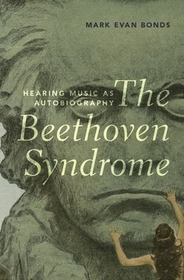
The Beethoven Syndrome
Hearing Music as Autobiography
- Publisher's listprice GBP 36.49
-
17 433 Ft (16 602 Ft + 5% VAT)
The price is estimated because at the time of ordering we do not know what conversion rates will apply to HUF / product currency when the book arrives. In case HUF is weaker, the price increases slightly, in case HUF is stronger, the price goes lower slightly.
- Discount 10% (cc. 1 743 Ft off)
- Discounted price 15 689 Ft (14 942 Ft + 5% VAT)
Subcribe now and take benefit of a favourable price.
Subscribe
17 433 Ft

Availability
printed on demand
Why don't you give exact delivery time?
Delivery time is estimated on our previous experiences. We give estimations only, because we order from outside Hungary, and the delivery time mainly depends on how quickly the publisher supplies the book. Faster or slower deliveries both happen, but we do our best to supply as quickly as possible.
Product details:
- Publisher OUP USA
- Date of Publication 30 January 2020
- ISBN 9780190068479
- Binding Hardback
- No. of pages344 pages
- Size 160x236x35 mm
- Weight 612 g
- Language English
- Illustrations 4 halftones 0
Categories
Short description:
The Beethoven Syndrome: Hearing Music as Autobiography traces the rise, fall, and persistence of a radical new mode of listening from the middle of the eighteenth century to the present.
MoreLong description:
The "Beethoven Syndrome" is the inclination of listeners to hear music as the projection of a composer's inner self. This was a radically new way of listening that emerged only after Beethoven's death. Beethoven's music was a catalyst for this change, but only in retrospect, for it was not until after his death that listeners began to hear composers in general-and not just Beethoven-in their works, particularly in their instrumental music.
The Beethoven Syndrome: Hearing Music as Autobiography traces the rise, fall, and persistence of this mode of listening from the middle of the eighteenth century to the present. Prior to 1830, composers and audiences alike operated within a framework of rhetoric in which the burden of intelligibility lay squarely on the composer, whose task it was to move listeners in a calculated way. But through a confluence of musical, philosophical, social, and economic changes, the paradigm of expressive objectivity gave way to one of subjectivity in the years around 1830. The framework of rhetoric thus yielded to a framework of hermeneutics: concert-goers no longer perceived composers as orators but as oracles to be deciphered.
In the wake of World War I, however, the aesthetics of "New Objectivity" marked a return not only to certain stylistic features of eighteenth-century music but to the earlier concept of expression itself. Objectivity would go on to become the cornerstone of the high modernist aesthetic that dominated the century's middle decades. Masterfully citing a broad array of source material from composers, critics, theorists, and philosophers, Mark Evan Bonds's engaging study reveals how perceptions of subjective expression have endured, leading to the present era of mixed and often conflicting paradigms of listening.
A tour de force of scholarship and argumentation. Reconstructing the changing discourses surrounding music in different decades of European history, Bonds boldly challenges commonly held beliefs about composers "expressing themselves" in music.
Table of Contents:
Introduction: The Instrumental Self
Part 1: The Paradigm of Objective Expression: 1770-1830
Chapter 1: The Framework of Rhetoric
Chapter 2: Toward Subjective Expression
Chapter 3: The Composer in the Work
Part 2: The Paradigm of Subjective Expression: 1830-1920
Chapter 4: The Framework of Hermeneutics
Chapter 5: First-Person Beethoven
Chapter 6: After Beethoven
Part 3: Dual Paradigms: Since 1920
Chapter 7: The Return of Objectivity
Chapter 8: The Endurance of Subjectivity
Conclusion: Tracking Comets
Bibliography

