

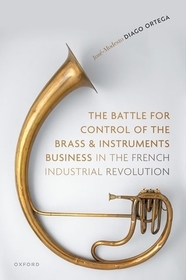
The Battle for Control of the Brass and Instruments Business in the French Industrial Revolution
- Publisher's listprice GBP 30.00
-
13 545 Ft (12 900 Ft + 5% VAT)
The price is estimated because at the time of ordering we do not know what conversion rates will apply to HUF / product currency when the book arrives. In case HUF is weaker, the price increases slightly, in case HUF is stronger, the price goes lower slightly.
- Discount 10% (cc. 1 355 Ft off)
- Discounted price 12 191 Ft (11 610 Ft + 5% VAT)
Subcribe now and take benefit of a favourable price.
Subscribe
13 545 Ft

Availability
Estimated delivery time: In stock at the publisher, but not at Prospero's office. Delivery time approx. 3-5 weeks.
Not in stock at Prospero.
Why don't you give exact delivery time?
Delivery time is estimated on our previous experiences. We give estimations only, because we order from outside Hungary, and the delivery time mainly depends on how quickly the publisher supplies the book. Faster or slower deliveries both happen, but we do our best to supply as quickly as possible.
Product details:
- Publisher OUP Oxford
- Date of Publication 10 October 2024
- ISBN 9780198895053
- Binding Hardback
- No. of pages320 pages
- Size 240x162x20 mm
- Weight 670 g
- Language English 536
Categories
Short description:
The Battle for Control of the Brass and Instruments Business in the French Industrial Revolution narrates and analyzes the largest judicial battle in culture and industrial property in nineteenth century Europe, the echoes of which still ring today.
MoreLong description:
The Battle for Control of the Brass and Instruments Business in the French Industrial Revolution narrates and analyzes the largest judicial battle in culture and industrial property in nineteenth century Europe, the echoes of which still ring today.
The battle was about simple wind instruments made of brass and their related patents, not by opera - the musical genre that moved the most money and people at the time - or the revered and contentious high art. Music, in all its dimensions, had become a business. The nineteenth-century French industry of brasswinds shows how the strategic parameters of the Industrial Revolution and, essentially, the system that sustained them (capitalism), permeated everything. What lay behind those contentious disputes was the pursuit of commercial profit, and the consolidation of a dominant position that would yield the maximum possible economic return. The legal confrontation began when a group of French businessmen who built wind instruments saw their business and sources of financing threatened after being forced by the Army to use a series of musical instruments that were different to the usual ones and protected by patents for invention that belonged to Adolphe Sax, the inventor of the saxophone.
Diago Ortega provides evidence of how political power was used by economic power, and presents arguments on how culture articulated the social machinery and was a powerful tool for legitimizing political positions.
Table of Contents:
Part 1: DEFENCE
Chimaeras, Tall Tales, and 'Joke-Horns' in First Instance: Presentation of the Bases of Prosecution and Defence
'Let Him Calm Down' and the Report of the Lumières: The Position of the Prosecutor and the Technical Report
Judicial Setback or 'Nothing Patentable': Change of Regime and Procedural Course
Appel-incident or Ascent to Appeal
Persistence and Jump to Cassation
The Egg of Columbus and a Great Victory: The Denouement of the Civil Prosecution
Part 2: CHARGE!
Hasty Raids
Gautrot or 'the Most Relentless Fighting Spectacle Between Makers': Double Resistance and Exhaustion
Masterstroke: The Extension of Contested Patents
With Malice Aforethought: Squeezing Out the Deadlines
Besson, a Brass Heavyweight Maker
Versus Eighteen... at the Same Time: Collective Confrontation
Tentacles in Strasbourg: Competition from Outside Paris
Transfer and Escape to London: The Resistance of Besson
Drouelle or the Valve Big Business
Endgame and Epilogue

