
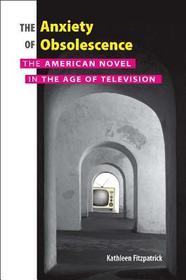
Anxiety of Obsolescence – The American Novel in the Age of Television
The American Novel in the Age of Television
- Publisher's listprice GBP 32.00
-
15 288 Ft (14 560 Ft + 5% VAT)
The price is estimated because at the time of ordering we do not know what conversion rates will apply to HUF / product currency when the book arrives. In case HUF is weaker, the price increases slightly, in case HUF is stronger, the price goes lower slightly.
- Discount 10% (cc. 1 529 Ft off)
- Discounted price 13 759 Ft (13 104 Ft + 5% VAT)
Subcribe now and take benefit of a favourable price.
Subscribe
15 288 Ft
Availability
Not yet published.
Why don't you give exact delivery time?
Delivery time is estimated on our previous experiences. We give estimations only, because we order from outside Hungary, and the delivery time mainly depends on how quickly the publisher supplies the book. Faster or slower deliveries both happen, but we do our best to supply as quickly as possible.
Product details:
- Publisher University of Chicago Press
- Date of Publication 25 March 2026
- Number of Volumes Paperback
- ISBN 9780826515209
- Binding Paperback
- No. of pages288 pages
- Size 228x152 mm
- Weight 400 g
- Language English
- Illustrations index, bibliography 700
Categories
Short description:
It almost goes without saying that the rise in popularity of television has killed the audience for ""serious"" literature. This book traces the ways in which a small cadre of writers of ""serious"" literature - DeLillo, Pynchon, and Franzen, for instance - have propagated this myth in order to set themselves up as the last bastions of good writing.
MoreLong description:
It almost goes without saying that the rise in popularity of television has killed the audience for ""serious"" literature. This is such a given that reading Fitzpatrick's challenge to this notion can be very disconcerting, as she traces the ways in which a small cadre of writers of ""serious"" literature - DeLillo, Pynchon, and Franzen, for instance - have propagated this myth in order to set themselves up as the last bastions of good writing. Fitzpatrick first explores whether serious literature was ever as all-pervasive as critics of the television culture claim, and then asks the obvious question: what, or who, exactly, are these guys defending good writing against? Fitzpatrick examines the ways in which the anxiety about the supposed death of the novel is built on a myth of the novel's past ubiquity and its present displacement by television. She explores the ways in which this myth plays out in and around contemporary fiction, and how it serves as a kind of unacknowledged discourse about race, class, and gender. The declaration constructs a minority status for the ""white male author"" who needs protecting from television's largely female and increasingly non-white audience. The novel, then, is transformed from a primary means of communication into an ancient, almost forgotten, and thus, treasured form reserved for the well-educated and well-to-do, and the men who practice it are exalted as the practitioners of an almost lost art. Such positioning serves to further marginalize women writers and writers of color, because it makes the novel, by definition, the preserve of the poor endangered white man. If the novel is only a product of a small group of white men, how can the contributions of women and writers of color be recognized? Instead, this positioning abandons women and people of color to television as a creative outlet, and in return, cedes television to them. Fitzpatrick argues that there's a level of unrecognized patronization in assuming that television serves no purpose but to provide dumb entertainment to bored women and others too stupid to understand novels. And, instead, she demonstrates the real positive effects of a televisual culture.
More