

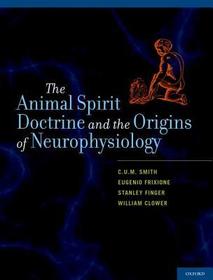
The Animal Spirit Doctrine and the Origins of Neurophysiology
- Publisher's listprice GBP 180.00
-
81 270 Ft (77 400 Ft + 5% VAT)
The price is estimated because at the time of ordering we do not know what conversion rates will apply to HUF / product currency when the book arrives. In case HUF is weaker, the price increases slightly, in case HUF is stronger, the price goes lower slightly.
- Discount 10% (cc. 8 127 Ft off)
- Discounted price 73 143 Ft (69 660 Ft + 5% VAT)
Subcribe now and take benefit of a favourable price.
Subscribe
81 270 Ft

Availability
printed on demand
Why don't you give exact delivery time?
Delivery time is estimated on our previous experiences. We give estimations only, because we order from outside Hungary, and the delivery time mainly depends on how quickly the publisher supplies the book. Faster or slower deliveries both happen, but we do our best to supply as quickly as possible.
Product details:
- Publisher OUP USA
- Date of Publication 2 August 2012
- ISBN 9780199766499
- Binding Hardback
- No. of pages304 pages
- Size 224x282x25 mm
- Weight 1270 g
- Language English 0
Categories
Short description:
For millennia, the activity of the nervous system was believed to be due to indwelling animal spirit. This book describes the rise, development, apex, and slow decline of this idea, and its replacement by physicochemical theories of nerve conduction. It is a history of physiology and of the origins of neuroscience.
MoreLong description:
How do we become aware of things and events in the outside world, and how does the brain control the muscular system and behavior? This book examines the history of Western attempts to explain how messages might be sent from the sense organs to the brain and from the brain to the muscles. It focuses on a construct called animal spirit, which would permeate philosophy and guide physiology and medicine for over two millennia.
The authors' story opens along the Eastern Mediterranean, where they examine how Pre-Socratic philosophers related the soul to air-wind or pneuma. They then trace what Hippocrates, Plato and Aristotle wrote about this pneuma, and how Stoic and Epicurean philosophers approached it. They also visit Alexandria, where Hellenistic anatomists provided new thoughts about the nerves and the ventricles. Thereafter, the authors return to the Greek mainland, where they show how Galen's pneuma psychikon or spiritus animae would provide an explanation for sensations and movements.
Galen's writings would guide science and medicine for well over a thousand years, albeit with some modifications. One change, found in early Christian writers Nemesius and Augustine, involved assigning perception, cognition, and memory to different spirit-filled ventricles. After examining how pious Scholastics later dealt with the nerve spirit, the authors turn to how questions began to be raised about it in the 1500s and 1600s. Here they examine the rise of modern science with its revealing experiments, microscopic observations, and attempts to break with the past. Descartes, Swammerdam, Borelli, Glisson, Willis, Newton, Hartley, Boerhaave and Haller are among the featured players in this part of the story.
Nevertheless, the animal spirit doctrine continued to survive (although modified), because no adequate replacement for it was immediately forthcoming. The replacement theory stemmed from experiments on electric fishes started in the 1750s. Additional research on these fishes and then on frogs eventually led scientists to abandon their time-honored ideas. The authors trace some of the developments leading to modern electrophysiology and end with an epilogue centered on what this history teaches us about paradigmatic changes in the life sciences.
Table of Contents:
Section 1: The Doctrine Introduced
Introduction
Chronology
Chapter 1: Psyche and soma
Chapter 2: Alexandria and Hellenistic psychophysiology
Section 2: The Doctrine Established
Introduction
Chronology
Chapter 3: Biblical anima-spirit
Chapter 4: The Islamic Ascendancy
Chapter 5: Animal spirit in an age of Faith
Section 3: The Doctrine Questioned
Introduction
Chronology
Chapter 6: Descartes
Chapter 7: Experiment and observation
Chapter 8: Theory and argument
Section 4: The Doctrine in Retreat
Introduction
Chronology
Chapter 9: Vibrations and subtle fluids
Chapter 10: Animal spirit in action
Chapter 11: Non-spiritual physiology I: "Physic " rather than "Psychic " Functions
Chapter 12 Non-spiritual physiology II: Irritable fibers
Section 5: The Doctrine Discarded
Introduction
Chronology
Chapter 13: The increasingly electrical world
Chapter 14: Electric fishes and the path to animal electricity
Chapter 15: From Fish to Frogs and nerve Electricity
Epilogue
Bibliography
Index

