

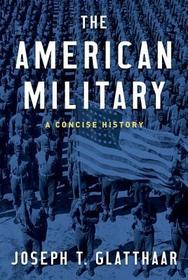
The American Military
A Concise History
- Publisher's listprice GBP 14.99
-
6 767 Ft (6 445 Ft + 5% VAT)
The price is estimated because at the time of ordering we do not know what conversion rates will apply to HUF / product currency when the book arrives. In case HUF is weaker, the price increases slightly, in case HUF is stronger, the price goes lower slightly.
- Discount 10% (cc. 677 Ft off)
- Discounted price 6 091 Ft (5 801 Ft + 5% VAT)
Subcribe now and take benefit of a favourable price.
Subscribe
6 767 Ft

Availability
Estimated delivery time: In stock at the publisher, but not at Prospero's office. Delivery time approx. 3-5 weeks.
Not in stock at Prospero.
Why don't you give exact delivery time?
Delivery time is estimated on our previous experiences. We give estimations only, because we order from outside Hungary, and the delivery time mainly depends on how quickly the publisher supplies the book. Faster or slower deliveries both happen, but we do our best to supply as quickly as possible.
Product details:
- Publisher OUP USA
- Date of Publication 11 October 2018
- ISBN 9780190692810
- Binding Hardback
- No. of pages152 pages
- Size 213x145x17 mm
- Weight 318 g
- Language English
- Illustrations 10 0
Categories
Short description:
The American Military: A Concise History narrates the American military experience. It focuses on four recurring themes-- citizen soldiers vs. the standing armed forces; military professionalism; mechanization and technology; and the limits of power--and illuminates the role of the American military in its past and how it is shaping current and future national security issues.
MoreLong description:
Since the first English settlers landed at Jamestown with the legacy of centuries of European warfare in tow, the military has been an omnipresent part of America. In The American Military: A Concise History, Joseph T. Glatthaar explores this relationship from its origins in the thirteen colonies to today's ongoing conflicts in the Middle East.
Colonial Americans struggled to reconcile the rights of the citizenry to form local militias with the existence of a standing army, viewing it as a threat to civil liberty. This tension played out during the Revolution as General Washington's rag-tag band of "Continentals" was largely neglected by the public as it bravely faced the British redcoats. The Founding Fathers attempted to strike a balance, enshrining an army, navy, and a "well regulated Militia" in the Constitution. As such, the United States soon witnessed the rise of a professional military, with its commitment to selectivity and expertise, a boon to the nation's successes in the War of 1812, the Mexican War, and the Civil War to come.
This system would give rise to great generals such as Ulysses S. Grant and Robert E. Lee, both graduates of West Point, and great naval commanders such as Matthew Perry, hero of the Battle of Lake Erie. As a testament to this system, the officer corps would lead the immense armies and ships of the Union and Confederacy with skill and professionalism. However, the United States quickly dismantled the world's finest army and navy after the war--but soon learned that the purpose of a peacetime army is to prepare for war.
When war did arrive, it arrived with a vengeance, gutting the trenches of the Great War with effective innovations: tanks, planes, machine guns, and poison gas. The U.S. military strategically embraced the technology that would win both world wars. From the great aircraft carriers of the Pacific, the Sherman tanks of the Allied front, to the finality of the atomic bomb, this turn to technology changed the nature of battle in the Second World War.
The nuclear era brought encounters defined by stalemate--from the damaging Cold War conflicts of Korea and Vietnam, and an all-time high in hostility towards the military during Vietnam, to the current engagements in Afghanistan and Iraq. Since the events of 9/11, the United States has been frustrated by unconventional warfare, including terrorism and cyberwar, largely negating the technological advantage it has held since the Second World War. Glatthaar examines this challenge, looking to the future of the U.S. military and its often proud and complicated legacy.
A launching pad for your exploration of American military history ... Glatthaar invites readers to think more broadly about the role of the military in the democratic US nation.
Table of Contents:
Preface
Introduction
Chapter 1: Citizen Soldier vs. Standing Army
Chapter 2: Struggle for Military Professionalism
Chapter 3: Technology and Mechanization
Chapter 4: The Limits of Power
Conclusion
Further Reading
Index

