

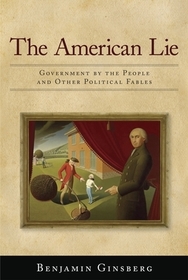
The American Lie
Government by the People and Other Political Fables
- Publisher's listprice GBP 24.99
-
11 282 Ft (10 745 Ft + 5% VAT)
The price is estimated because at the time of ordering we do not know what conversion rates will apply to HUF / product currency when the book arrives. In case HUF is weaker, the price increases slightly, in case HUF is stronger, the price goes lower slightly.
- Discount 10% (cc. 1 128 Ft off)
- Discounted price 10 154 Ft (9 671 Ft + 5% VAT)
Subcribe now and take benefit of a favourable price.
Subscribe
11 282 Ft

Availability
printed on demand
Why don't you give exact delivery time?
Delivery time is estimated on our previous experiences. We give estimations only, because we order from outside Hungary, and the delivery time mainly depends on how quickly the publisher supplies the book. Faster or slower deliveries both happen, but we do our best to supply as quickly as possible.
Product details:
- Publisher OUP USA
- Date of Publication 14 March 2013
- ISBN 9780199945955
- Binding Paperback
- No. of pages256 pages
- Size 224x150x17 mm
- Weight 363 g
- Language English 0
Categories
Short description:
Going all the way back to the time of George Washington, much of what we see and hear in the political world consists of lies and deceptions. Despite assurances to the contrary, politics is not about truth, justice, and principle. It is about money, power, and status. As astute political commentator Ben Ginsberg convincingly demonstrates, politicians habitually lie, pretending to fight for principles, in order to conceal their true selfish motives. Citizens who need the frequent injunctions to participate in politics and abjure political cynicism are likely to be duped into contributing their tax dollars and even their lives for dubious purposes. Most individuals gain little from political participation. Participants are the foot soldiers of political warfare, but even if their side is victorious, they receive few of the spoils of war. Thus, in this new political season, Ginsberg encourages citizens to think outside the (ballot) box, finding new ways to act on behalf of their interests and the public good. But if they do vote, their motto should be when in doubt vote them out. The elections of 2008 are a good time to begin.
MoreLong description:
Going all the way back to the time of George Washington, much of what we see and hear in the political world consists of lies and deceptions. Despite assurances to the contrary, politics is not about truth, justice, and principle. It is about money, power, and status. As astute political commentator Ben Ginsberg convincingly demonstrates, politicians habitually lie, pretending to fight for principles, in order to conceal their true selfish motives. Citizens who need the frequent injunctions to participate in politics and abjure political cynicism are likely to be duped into contributing their tax dollars and even their lives for dubious purposes. Most individuals gain little from political participation. Participants are the foot soldiers of political warfare, but even if their side is victorious, they receive few of the spoils of war. Thus, in this new political season, Ginsberg encourages citizens to think outside the (ballot) box, finding new ways to act on behalf of their interests and the public good. But if they do vote, their motto should be when in doubt vote them out. The elections of 2008 are a good time to begin.
Ben Ginsberg s engaging jeremiad about the absence of truth in political discourse is in itself based on a big lie the author s claim that he is a dedicated cynic. His own words betray him as one of the few idealists remaining among us. And his trenchant analysis of America s mendacity-ridden politics demands our attention and respect.
Table of Contents:
1. Interests and Principles in Political Life
The Principles of Cynical Realism
Altruism and Interests
Interests and Principles
Principles as Political Weapons
Becoming Realistically Cynical
2. Public Opinion: Myths and Realities
Advertising
Publicity
Measuring Opinion
3. Elections and the Limits of Popular Government
Voting as a Means of Regulating
Popular Political Activity
The Limits of Voting
Political Marketing
4. Private Interests and Public Policies
Mobilization Bias
Organizational Bias
Private Capture
Pathologies of Government
5. Popular Influence and State Power
Who Governs?
Delegation of Power
Presidential Power
The Citizen and the State
6. Conclusion: Why Participate in Politics?
The Myth of Political Leadership
Public Lies and Private Purposes
State Secrets
Practicing Defensive Politics
Notes
Index
About the Author

