

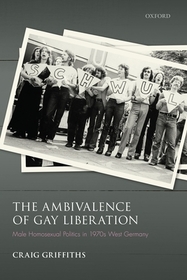
The Ambivalence of Gay Liberation
Male Homosexual Politics in 1970s West Germany
Series: Studies in German History;
- Publisher's listprice GBP 91.00
-
41 086 Ft (39 130 Ft + 5% VAT)
The price is estimated because at the time of ordering we do not know what conversion rates will apply to HUF / product currency when the book arrives. In case HUF is weaker, the price increases slightly, in case HUF is stronger, the price goes lower slightly.
- Discount 10% (cc. 4 108 Ft off)
- Discounted price 36 978 Ft (35 217 Ft + 5% VAT)
Subcribe now and take benefit of a favourable price.
Subscribe
41 086 Ft

Availability
Estimated delivery time: In stock at the publisher, but not at Prospero's office. Delivery time approx. 3-5 weeks.
Not in stock at Prospero.
Why don't you give exact delivery time?
Delivery time is estimated on our previous experiences. We give estimations only, because we order from outside Hungary, and the delivery time mainly depends on how quickly the publisher supplies the book. Faster or slower deliveries both happen, but we do our best to supply as quickly as possible.
Product details:
- Edition number 1
- Publisher OUP Oxford
- Date of Publication 25 February 2021
- ISBN 9780198868965
- Binding Hardback
- No. of pages254 pages
- Size 240x165x20 mm
- Weight 528 g
- Language English 65
Categories
Short description:
This book explores the different ways West Germans thought about and discussed being queer in the 1970s; a decade in the midst of the Cold War, sandwiched between the decriminalisation of homosexuality in 1969 and the HIV/AIDS crisis in the early 1980s.
MoreLong description:
The Ambivalence of Gay Liberation explores ways of thinking, feeling, and talking about being gay in the 1970s, an influential decade sandwiched between the partial decriminalisation of male homosexuality in 1969, and the arrival of the HIV/AIDS crisis in the early 1980s. Moving beyond divided Cold War Berlin, it also focuses on lesser-known cities, such as Aachen, Cologne, Frankfurt, Münster, and Stuttgart, to name just a few of the 53 localities that were home to a gay group by the end of the 1970s. These groups were important, and this book tells their story.
In 1970s West Germany gay liberation did not take place only in activist meetings, universities, and on street demonstrations, but also on television, in magazine editorial offices, ordinary homes, bedrooms, and beyond. In considering all these spaces and individuals, this book provides a more complex account than previous histories, which have tended to focus only on a social movement and only on the idea of 'gay pride'. By drawing attention to ambivalence, this book shows that gay liberation was never only about pride, but also about shame; characterized not only by hope, but also by fear; and driven forward not just by the pushes of confrontation, but also by the pulls of conformism. Ranging from the painstaking emergence of the gay press to the first representation of homosexuality on television, from debates over the sexual legacy of 1968 and the student movement to the memory of Nazi persecution, The Ambivalence of Gay Liberation is the first English-language book to tell the story of male homosexual politics in 1970s West Germany. In doing so, this book changes the way we think about modern queer history.
Griffiths offers a comprehensive and convincing account of the gay movement of the 1970s.
Table of Contents:
Introduction
The West German gay world after homosexual law reform
'It is not the Homosexual who is perverse': the emergence of gay liberation
Gay liberation, "1968", and the alternative left
The pink triangle: persecution past and present
Thinking and feeling homosexuality
Conclusion

