

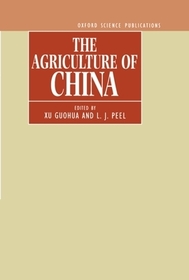
The Agriculture of China
Series: Centre for Agricultural Strategy Series; 2;
- Publisher's listprice GBP 102.50
-
46 278 Ft (44 075 Ft + 5% VAT)
The price is estimated because at the time of ordering we do not know what conversion rates will apply to HUF / product currency when the book arrives. In case HUF is weaker, the price increases slightly, in case HUF is stronger, the price goes lower slightly.
- Discount 10% (cc. 4 628 Ft off)
- Discounted price 41 651 Ft (39 668 Ft + 5% VAT)
Subcribe now and take benefit of a favourable price.
Subscribe
46 278 Ft

Availability
Out of print
Why don't you give exact delivery time?
Delivery time is estimated on our previous experiences. We give estimations only, because we order from outside Hungary, and the delivery time mainly depends on how quickly the publisher supplies the book. Faster or slower deliveries both happen, but we do our best to supply as quickly as possible.
Product details:
- Publisher OUP Oxford
- Date of Publication 16 May 1991
- ISBN 9780198592082
- Binding Hardback
- No. of pages318 pages
- Size 234x156 mm
- Weight 650 g
- Language English
- Illustrations halftone, line figures, tables 0
Categories
Short description:
The majority of the vast population of China are either directly involved or economically dependent on agricultural production. Set within the context of the natural environment, this book examines each component of agriculture separately, before bringing together the ten agricultural regions of China. Each region is described in detail and its problems outlined.
Substantials changes have occured since the economic reforms of 1979 and these are discussed. The book summarizes the characteristics and problems of Chinese agriculture and looks to its future, as seen by a Chinese agronomist today.
Long description:
Eleven hundred million people live in China today, most of them directly involved with or economically dependent on agricultural production. To know about the peasants and the rural areas is to know much about China. This book, written by Chinese experts, sets the scene with a description of the natural environment. Within this context, the components of agriculture are examined separately before being brought together in a consideration of the ten agricultural
regions of China. Each region is described in detail with particular emphasis on the problems faced in each.
The economic reforms of 1979 onward have brought substantial changes, and these are discussed in detail. The book concludes with a summary of the characteristics and problems of Chinese agriculture and the prospects for the future as seen by a Chinese agronomist today.
'This book presents interesting and novel information for those readers seeking to learn about the agriculture of China. The text is clearly produced, and the figures and tables well laid out. Each part includes a list of relevant references. All in all, this is a valuable book for anyone interested in a better understanding of the many facets of Chinese agriculture.'
Wan Xia, Agricultural Systems 39 (1992)
Table of Contents:
Xu Guohua: Natural environment; Dong Kaichen: The historical and social background; Chen Ren (with a section on Fishery by Zhang Lin): The components of agriculture; Yang Shenghua: The ten agricultural regions of China; Wang Weixin, Mei Dunli, Yu Yifan, Ke Baokang, Zhang Qizong & Zhu Zhaoling: Infrastructure and agricultural inputs; Chen Dao, Xie Lifeng & Yao Chaohui: The rural economy; Li Xiaochun: Agricultural education, research, and extension; Xu Guohua:
Summary and conclusions: the characteristics and problems of Chinese agriculture and prospects for the future; References; Appendices; Index.

