

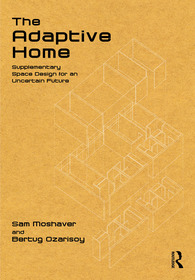
The Adaptive Home
Supplementary Space Design for an Uncertain Future
-
GET 10% OFF
- Publisher's listprice GBP 37.99
-
17 152 Ft (16 335 Ft + 5% VAT)
The price is estimated because at the time of ordering we do not know what conversion rates will apply to HUF / product currency when the book arrives. In case HUF is weaker, the price increases slightly, in case HUF is stronger, the price goes lower slightly.
- Discount 10% (cc. 1 715 Ft off)
- Discounted price 15 437 Ft (14 702 Ft + 5% VAT)
15 437 Ft

Availability
Not yet published.
Why don't you give exact delivery time?
Delivery time is estimated on our previous experiences. We give estimations only, because we order from outside Hungary, and the delivery time mainly depends on how quickly the publisher supplies the book. Faster or slower deliveries both happen, but we do our best to supply as quickly as possible.
Product details:
- Edition number 1
- Publisher Routledge
- Date of Publication 20 August 2026
- ISBN 9781041051770
- Binding Paperback
- No. of pages364 pages
- Size 254x178 mm
- Weight 90 g
- Language English
- Illustrations 147 Illustrations, black & white; 59 Illustrations, color; 56 Halftones, black & white; 59 Halftones, color; 91 Line drawings, black & white; 11 Tables, black & white 700
Categories
Short description:
This book aims to provide a comprehensive guide for architects, urban planners, and developer on designing and retrofitting multi-family housing to meet the evolving needs of residents in a post-COVID world.
MoreLong description:
This book aims to provide a comprehensive guide for architects, urban planners, and developer on designing and retrofitting multi-family housing to meet the evolving needs of residents in a post-COVID world.
Drawing on extensive research and case studies, it illustrates how the concept of "supplementary space" can be integrated into multi-family dwellings to enhance adaptability and resilience. The book demonstrates how emerging needs, such as working from home, can be accommodated through innovative design strategies that promote flexibility without compromising the overall integrity of the living space. Using a systems approach and the principles of Open Building, this work presents practical guidelines for incorporating Supplementary Spaces into various housing typologies. It explores how these adaptable spaces can be materialised using industrialised building systems and Design for Disassembly (DfD) approaches, ensuring long-term sustainability and reducing waste. This book also addresses the critical balance between individual needs and collective living in multi-family housing, offering solutions that enhance privacy, productivity, and well-being.
By bridging theory and practice, this book seeks to transform how we conceive and construct multi-family housing. It provides a roadmap for creating homes that can evolve with changing lifestyles, demographic shifts, and unforeseen global challenges. Ultimately, this work aims to contribute to the development of more resilient, sustainable, and human-centered urban environments that can adapt to future needs while improving the quality of life for residents.
MoreTable of Contents:
1. Dwelling Unit Changes and Emerging Needs in Global Urban Centres. 2. Intergrating Adaptable Framework for Emerging Needs. 3. Supplementary Space and the Systems Approach. 4. Scenario-Building: Working-from-Home. 5. Knowledge Model and Synthesis of Criteria. 6. Applying and Testing the Generic Model across Multi-Family Housing Types. 7. System-Level Strategies for Materialising Supplementary Space in Multi-Family Housing. 8. Conclusions: Towards a Framework for Resilient Living.
More
