

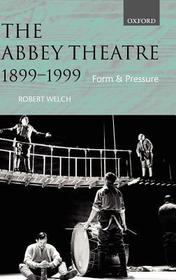
The Abbey Theatre, 1899-1999
Form and Pressure
- Publisher's listprice GBP 160.00
-
72 240 Ft (68 800 Ft + 5% VAT)
The price is estimated because at the time of ordering we do not know what conversion rates will apply to HUF / product currency when the book arrives. In case HUF is weaker, the price increases slightly, in case HUF is stronger, the price goes lower slightly.
- Discount 10% (cc. 7 224 Ft off)
- Discounted price 65 016 Ft (61 920 Ft + 5% VAT)
Subcribe now and take benefit of a favourable price.
Subscribe
72 240 Ft

Availability
printed on demand
Why don't you give exact delivery time?
Delivery time is estimated on our previous experiences. We give estimations only, because we order from outside Hungary, and the delivery time mainly depends on how quickly the publisher supplies the book. Faster or slower deliveries both happen, but we do our best to supply as quickly as possible.
Product details:
- Publisher OUP Oxford
- Date of Publication 21 October 1999
- ISBN 9780198121879
- Binding Hardback
- No. of pages294 pages
- Size 241x163x21 mm
- Weight 533 g
- Language English
- Illustrations 1 frontispiece 0
Categories
Short description:
A century ago this year, productions of W. B. Yeats's The Countess Cathleen and Edward Martyn's The Heather Field launched what was to become Ireland's National Theatre, named after its home in Abbey Street, Dublin. This is the first history of the Abbey Theatre to set the plays and the personalities in their historical and political context and to describe the theatre's artistic and financial development to the present day. Outstanding plays and persistent dramatic themes are discussed alongside the Abbey's people-not just the playwrights, poets, and actors who supply its dramatic life but also the directors and policy-makers whose struggle for financial security, subsidy, and new-style 'partnerships' form a crucial part of its story.
MoreLong description:
A century ago this year, productions of W. B. Yeats's The Countess Cathleen and Edward Martyn's The Heather Field inaugurated the Irish Literary Theatre, which was to take its name from its home in Abbey Street, Dublin. Despite riot, fire, and critical controversy, the Abbey Theatre has housed Ireland's National Theatre ever since: at once the catalyst and focus for the almost unprecedented renaissance of drama witnessed by Ireland in the twentieth century. This is the first history of the Abbey to discuss the plays and the personalities in their underlying historical and political context, to give due weight to the theatre's work in Irish, and to take stock of its artistic and financial development up to the present. The research for the book draws extensively on archive sources, especially the manuscript holdings on the Abbey at the National Library of Ireland.
Many outstanding plays are examined, with detailed analysis of their form and their affective and emotional content; and persistent themes in the Abbey's output are identified - visions of an ideal community; the revival of Irish; the hunger for land and money; the restrictions of a society undergoing profound change. But these are integrated with accounts of the Abbey's people, from Yeats, Martyn, and Lady Gregory, whose brainchild it was, to the actors, playwrights, directors, and managers who have followed - among them the Fays, Synge, O'Casey, Murray, Robinson, Shiels, Johnston, Murphy, Molloy, Friel, McGuiness, Deevy, Carr, and many others. The role of directors and policy-makers, and the struggle for financial security, subsidy, and new-style 'partnerships', is discussed as a crucial part of the theatre's continuing evolution.
Welch is persuasive in his detailed analysis of the major playwrights of Abbey history. He superbly charts Yeats's theatrical explorations ... His insights on the work and its relationship to the evolution of Irish society are perceptive and illuminating.
Table of Contents:
Prologue 1.
1899-1902, 'Four Green Fields'
1902-1910, 'Screeching in a Straightened Waistcoat'
1911-1925, 'O Absalom, my son'
1926-1951, 'The birth of a nation is no immaculate conception'
1951-1966, 'I remember everything'
1966-1985, 'History is personal'
1985-1999, 'The dead are not the past, the dead are the future'
Epilogue
Notes
Bibliography
Index

