

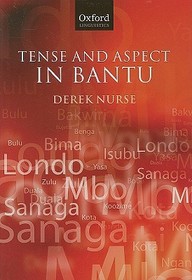
Tense and Aspect in Bantu
- Publisher's listprice GBP 192.50
-
91 966 Ft (87 587 Ft + 5% VAT)
The price is estimated because at the time of ordering we do not know what conversion rates will apply to HUF / product currency when the book arrives. In case HUF is weaker, the price increases slightly, in case HUF is stronger, the price goes lower slightly.
- Discount 10% (cc. 9 197 Ft off)
- Discounted price 82 770 Ft (78 828 Ft + 5% VAT)
Subcribe now and take benefit of a favourable price.
Subscribe
91 966 Ft

Availability
printed on demand
Why don't you give exact delivery time?
Delivery time is estimated on our previous experiences. We give estimations only, because we order from outside Hungary, and the delivery time mainly depends on how quickly the publisher supplies the book. Faster or slower deliveries both happen, but we do our best to supply as quickly as possible.
Product details:
- Publisher OUP Oxford
- Date of Publication 3 July 2008
- ISBN 9780199239290
- Binding Hardback
- No. of pages424 pages
- Size 252x176x28 mm
- Weight 900 g
- Language English
- Illustrations 7 maps, 11 tables 0
Categories
Short description:
Derek Nurse looks at variations in the form and function of tense and aspect in Bantu, a branch of Niger-Congo, the world's largest language phylum. His account is based on data from more than 200 Bantu languages and varieties, a representative sample of which is freely available on the publisher's website.
MoreLong description:
Derek Nurse looks at variations in the form and function of tense and aspect in Bantu, a branch of Niger-Congo, the world's largest language phylum. Bantu languages are spoken in central, eastern, and southern sub-Saharan Africa south of a line between Nigeria and Somalia. By current estimates there are between 250 and 600 of them, as yet neither adequately classified nor fully described. Professor Nurse's account is based on data from more than 200 Bantu languages and varieties, a representative sample of which is freely available on the publisher's website.
He devotes substantial chapters to the analysis and comparison of the different tense and aspect systems found in Bantu. He also examines the verbal categories with which they interact, including negation and focus. Synchronic and diachronic perspectives are interwoven throughout the book. Following a brief history of Bantu over the last five thousand years, the final two chapters look systematically at the history of tense and aspect in Bantu. The first deals with the reconstruction of the earlier forms from which contemporary structures, morphemes, and categories are derived, and the second with the processes of change, including grammaticalization, by means of which older analytical structures and independent lexical items moved as they became incorporated as grammatical inflections and categories.
Table of Contents:
Introduction
Verb Structure and Categories in Bantu
Tense
Aspect
Other Categories
What Can be Assumed for Proto-Bantu?
Processes of Change
Appendices
Acknowledgements

