

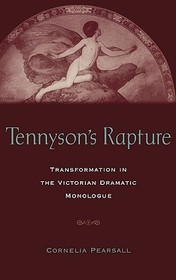
Tennyson's Rapture
Transformation in the Victorian Dramatic Monologue
- Publisher's listprice GBP 93.00
-
41 989 Ft (39 990 Ft + 5% VAT)
The price is estimated because at the time of ordering we do not know what conversion rates will apply to HUF / product currency when the book arrives. In case HUF is weaker, the price increases slightly, in case HUF is stronger, the price goes lower slightly.
- Discount 10% (cc. 4 198 Ft off)
- Discounted price 37 791 Ft (35 991 Ft + 5% VAT)
Subcribe now and take benefit of a favourable price.
Subscribe
41 989 Ft

Availability
printed on demand
Why don't you give exact delivery time?
Delivery time is estimated on our previous experiences. We give estimations only, because we order from outside Hungary, and the delivery time mainly depends on how quickly the publisher supplies the book. Faster or slower deliveries both happen, but we do our best to supply as quickly as possible.
Product details:
- Publisher OUP USA
- Date of Publication 21 February 2008
- ISBN 9780195150544
- Binding Hardback
- No. of pages408 pages
- Size 160x236x33 mm
- Weight 728 g
- Language English
- Illustrations 9 halftones 0
Categories
Short description:
This book explores Tennyson's representation of rapture as a radical mechanism of transformation--theological, social, political, or personal--and as a figure for critical processes in his own poetics. Offering a new approach to reading Victorian dramatic monologues, Pearsall probes the complex aims of these performances, showing how speakers' ambitions are both articulated in, and attained through, their consequential speech.
MoreLong description:
In the wake of the death of his friend Arthur Henry Hallam, the subject of In Memoriam, Alfred Tennyson wrote a range of intricately connected poems, many of which feature pivotal scenes of rapture, or being carried away. This book explores Tennyson's representation of rapture as a radical mechanism of transformation-theological, social, political, or personal-and as a figure for critical processes in his own poetics. The poet's fascination with transformation is figured formally in the genre he is credited with inventing, the dramatic monologue. Tennyson's Rapture investigates the poet's previously unrecognized intimacy with the theological movements in early Victorian Britain that are the acknowledged roots of contemporary Pentacostalism, with its belief in the oncoming Rapture, and its formative relation to his poetic innovation. Tennyson's work recurs persistently as well to classical instances of rapture, of mortals being borne away by immortals. Pearsall develops original readings of Tennyson's major classical poems through concentrated attention to his profound intellectual investments in advances in philological scholarship and archeological exploration, including pressing Victorian debates over whether Homer's raptured Troy was a verifiable site, or the province of the poet's imagination. Tennyson's attraction to processes of personal and social change is bound to his significant but generally overlooked Whig ideological commitments, which are illuminated by Hallam's political and philosophical writings, and a half-century of interaction with William Gladstone. Pearsall shows the comprehensive engagement of seemingly apolitical monologues with the rise of democracy over the course of Tennyson's long career. Offering a new approach to reading all Victorian dramatic monologues, this book argues against a critical tradition that sees speakers as unintentionally self-revealing and ignorant of the implications of their speech. Tennyson's Rapture probes the complex aims of these discursive performances, and shows how the ambitions of speakers for vital transformations in themselves and their circumstances are not only articulated in, but attained through, the medium of their monologues.
This impressively detailed and thoroughgoing monograph is one of the fullest appreciations of Tennyson's dramatic monologues yet written.

