

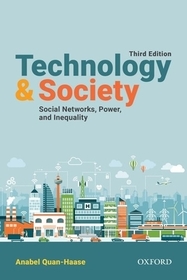
Technology and Society
Social Networks, Power, and Inequality
- Publisher's listprice GBP 97.99
-
44 242 Ft (42 135 Ft + 5% VAT)
The price is estimated because at the time of ordering we do not know what conversion rates will apply to HUF / product currency when the book arrives. In case HUF is weaker, the price increases slightly, in case HUF is stronger, the price goes lower slightly.
- Discount 10% (cc. 4 424 Ft off)
- Discounted price 39 818 Ft (37 922 Ft + 5% VAT)
Subcribe now and take benefit of a favourable price.
Subscribe
44 242 Ft

Availability
Only to order.
Why don't you give exact delivery time?
Delivery time is estimated on our previous experiences. We give estimations only, because we order from outside Hungary, and the delivery time mainly depends on how quickly the publisher supplies the book. Faster or slower deliveries both happen, but we do our best to supply as quickly as possible.
Product details:
- Edition number 3
- Publisher OUP Canada
- Date of Publication 4 June 2020
- ISBN 9780199032259
- Binding Paperback
- No. of pages376 pages
- Size 228x153x18 mm
- Weight 480 g
- Language English
- Illustrations 25 photos, 25 figures, 15 tables 0
Categories
Short description:
The only Canadian examination of the intersection of technology and society, connecting the reality of our technological age to communication, work, power, and inequality.
MoreLong description:
Series: Themes in Canadian Sociology
The only Canadian text to examine the intersection of technology and society through theories and real-world examples.
This fully updated third edition examines the places where technology and society intersect, connecting the reality of our technological age to issues of social networks, communication, identity, power, and inequality. The result is a comprehensive overview of the technological tools we use, where they come from, and how they are changing our perceptions of ourselves and the relationships we form.
Technology & Society provides an up-to-date overview of the sociological impacts of technology. It challenges students to think about the impacts of the technologies they use and design without forcing a single perspective or 'right' answer on them, instead prompting them to think about these issues for themselves."

