

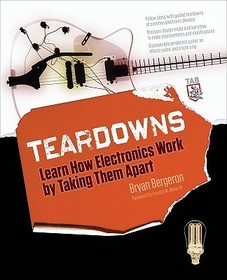
Teardowns: Learn How Electronics Work by Taking Them Apart
Series: ELECTRONICS;
- Publisher's listprice GBP 22.99
-
10 379 Ft (9 885 Ft + 5% VAT)
The price is estimated because at the time of ordering we do not know what conversion rates will apply to HUF / product currency when the book arrives. In case HUF is weaker, the price increases slightly, in case HUF is stronger, the price goes lower slightly.
- Discount 10% (cc. 1 038 Ft off)
- Discounted price 9 341 Ft (8 897 Ft + 5% VAT)
Subcribe now and take benefit of a favourable price.
Subscribe
10 379 Ft

Availability
cancelled
Why don't you give exact delivery time?
Delivery time is estimated on our previous experiences. We give estimations only, because we order from outside Hungary, and the delivery time mainly depends on how quickly the publisher supplies the book. Faster or slower deliveries both happen, but we do our best to supply as quickly as possible.
Product details:
- Publisher McGraw-Hill Education TAB
- Date of Publication 16 September 2010
- ISBN 9780071713344
- Binding Paperback
- No. of pages352 pages
- Size 231x185x17 mm
- Weight 610 g
- Language English 0
Categories
Short description:
A unique guide to learning electronics by taking apart everyday electronic devices to discover how they work.
MoreLong description:
Publisher's Note: Products purchased from Third Party sellers are not guaranteed by the publisher for quality, authenticity, or access to any online entitlements included with the product.
Learn Practical Electronics From a Skilled Mentor!
"The text is written as if Dr. Bergeron, who is a highly experienced electronics practitioner, is speaking directly to the reader with a point-by-point commentary about each teardown, complete with clear explanations of the operation and function of every component. By the time the product is completely disassembled, the reader understands the design tricks, component selection, and packaging choices that enabled the product to reach the market." -- From the Foreword by Forrest M. Mims III
Amp up your knowledge of electronics by deconstructing common devices and analyzing the revealed components and circuitry. Teardowns: Learn How Electronics Work by Taking Them Apart contains 14 projects that expose the inner workings of household appliances, workbench measuring instruments, and musical equipment. Discover how resistors, capacitors, sensors, transducers, and transistors function in real circuitry. You'll even get details on custom modifications to electric guitar pickups, an effects pedal, and a tube amp. Essential instructions for safely launching your own teardowns are also included in this hands-on guide.
- Learn about sensors and ICs from smoke detectors and motion-activated lights
- Work with the LCD and strain gauge transducers in a digital scale
- Discover how surge protectors, power conditioners, and UPS units function
- Study thermal design techniques in compact fluorescent bulbs
- Analyze the control systems in ultrasonic humidifiers and digital thermometers
- Understand how op amps and power ICs work in a hi-fi stereo amplifier
- Figure out how ultrasonic transducers work in a laser-guided measuring device
- Explore electric guitar pickups, effects pedals, and tube amplifiers
Make Great Stuff!
TAB, an imprint of McGraw-Hill Professional, is a leading publisher of DIY technology books for makers, hackers, and electronics hobbyists.
Publisher's Note: Products purchased from Third Party sellers are not guaranteed by the publisher for quality, authenticity, or access to any online entitlements included with the product.
Learn Practical Electronics From a Skilled Mentor!
"The text is written as if Dr. Bergeron, who is a highly experienced electronics practitioner, is speaking directly to the reader with a point-by-point commentary about each teardown, complete with clear explanations of the operation and function of every component. By the time the product is completely disassembled, the reader understands the design tricks, component selection, and packaging choices that enabled the product to reach the market." -- From the Foreword by Forrest M. Mims III
Amp up your knowledge of electronics by deconstructing common devices and analyzing the revealed components and circuitry. Teardowns: Learn How Electronics Work by Taking Them Apart contains 14 projects that expose the inner workings of household appliances, workbench measuring instruments, and musical equipment. Discover how resistors, capacitors, sensors, transducers, and transistors function in real circuitry. You'll even get details on custom modifications to electric guitar pickups, an effects pedal, and a tube amp. Essential instructions for safely launching your own teardowns are also included in this hands-on guide.
- Learn about sensors and ICs from smoke detectors and motion-activated lights
- Work with the LCD and strain gauge transducers in a digital scale
- Discover how surge protectors, power conditioners, and UPS units function
- Study thermal design techniques in compact fluorescent bulbs
- Analyze the control systems in ultrasonic humidifiers and digital thermometers
- Understand how op amps and power ICs work in a hi-fi stereo amplifier
- Figure out how ultrasonic transducers work in a laser-guided measuring device
- Explore electric guitar pickups, effects pedals, and tube amplifiers
Make Great Stuff!
TAB, an imprint of McGraw-Hill Professional, is a leading publisher of DIY technology books for makers, hackers, and electronics hobbyists.
Table of Contents:
Part I: Around the Home; Chapter 1. Dual Sensor Smoke Alarm; Chapter 2. Motion Activated LED Light; Chapter 3. Digital Bathroom Scale; Chapter 4. Surge Protective Devices; Chapter 5. Electronic Pedometer; Chapter 6. Compact Fluorescent(CF) Lamp; Chapter 7. Ultrasonic Humidifier; Chapter 8. Digital Hygro-Thermometer; Chapter 9. Stereo Power Amplifier; Part II: For Tinkerers; Chapter 10. Analog Volt-Ohm-Meter; Chapter 11. Laser-Guided Sonic Distance Measurer; Part III: For Musicians;Chapter 12. Electric Guitar; Chapter 13. Effects Pedal; Chapter 14. Vacuum Tube Guitar Amplifier; Part IV: Appendixes; Appendix A. Component Markings; Appendix B. Resources; Index
More
