

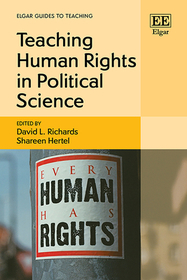
Teaching Human Rights in Political Science
Series: Elgar Guides to Teaching;
- Publisher's listprice GBP 110.00
-
49 665 Ft (47 300 Ft + 5% VAT)
The price is estimated because at the time of ordering we do not know what conversion rates will apply to HUF / product currency when the book arrives. In case HUF is weaker, the price increases slightly, in case HUF is stronger, the price goes lower slightly.
- Discount 10% (cc. 4 967 Ft off)
- Discounted price 44 699 Ft (42 570 Ft + 5% VAT)
Subcribe now and take benefit of a favourable price.
Subscribe
49 665 Ft

Availability
Estimated delivery time: In stock at the publisher, but not at Prospero's office. Delivery time approx. 3-5 weeks.
Not in stock at Prospero.
Why don't you give exact delivery time?
Delivery time is estimated on our previous experiences. We give estimations only, because we order from outside Hungary, and the delivery time mainly depends on how quickly the publisher supplies the book. Faster or slower deliveries both happen, but we do our best to supply as quickly as possible.
Product details:
- Publisher Edward Elgar
- Date of Publication 17 March 2026
- ISBN 9781035336586
- Binding Hardback
- No. of pages270 pages
- Size 234x156x18 mm
- Weight 487 g
- Language English 696
Categories
Long description:
This insightful book provides practical guidance for teaching human rights in post-secondary education political science courses. Leading and emerging scholars present a variety of pedagogical approaches, exploring major debates in the field and covering cutting-edge human rights research.
Each chapter is co-authored by a senior and early-career political scientist with clear learning outcomes identified and integrated practical exercises throughout. Chapters cover key topics such as international organizations, international law and courts, domestic political institutions, public policy mechanisms and the spaces in which human rights defenders take action. Contributing authors also address approaches grounded in theory, political economy, and qualitative, quantitative and mixed methods research, enabling instructors to demonstrate the roles of ideas, actors and institutions in realizing human dignity. Ultimately, Teaching Human Rights in Political Science provides a varied toolkit of learning techniques such as discussions, simulations, policy briefings and debates to help instructors maximize student engagement.
This book is an essential guide for political science instructors looking to build and enrich their teaching of human rights as well as educators across other disciplines seeking to engage with human rights in their classrooms. It is also a valuable resource for students and scholars in human rights law and international politics.
This is an open access title available under the terms of a CC BY-NC-ND 4.0 License. It is free to read, download and share via Elgaronline.com, thanks to generous funding support from The Gladstein Family Human Rights Institute, the Wiktor Osiatyński Chair of Human Rights Endowment, the University of Connecticut Department of Political Science, and the University of Connecticut Office of the Vice President for Research Scholarship Facilitation Fund.
This insightful book provides practical guidance for teaching human rights in post-secondary education political science courses. Leading and emerging scholars present a variety of pedagogical approaches, exploring major debates in the field and covering cutting-edge human rights research.
‘Human rights issues are an increasingly critical and challenging topic to address in the undergraduate classroom; still, its relevance to all subfields in our discipline must be taken seriously. This innovative collection of teaching materials and insights is a one-stop shop for political scientists looking to engage human rights in their courses – either for the first time or to refresh a long-standing course. The structure of the book into “arenas” and “lenses or approaches” is new and accessible for instructors, and notably centers the lived experiences of our students. Pedagogically sound and practical teaching tool!’

