

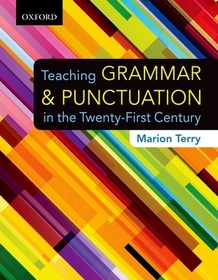
Teaching Grammar and Punctuation in the Twenty-First Century
- Publisher's listprice GBP 59.99
-
27 085 Ft (25 795 Ft + 5% VAT)
The price is estimated because at the time of ordering we do not know what conversion rates will apply to HUF / product currency when the book arrives. In case HUF is weaker, the price increases slightly, in case HUF is stronger, the price goes lower slightly.
- Discount 10% (cc. 2 709 Ft off)
- Discounted price 24 376 Ft (23 216 Ft + 5% VAT)
Subcribe now and take benefit of a favourable price.
Subscribe
27 085 Ft

Availability
Only to order.
Why don't you give exact delivery time?
Delivery time is estimated on our previous experiences. We give estimations only, because we order from outside Hungary, and the delivery time mainly depends on how quickly the publisher supplies the book. Faster or slower deliveries both happen, but we do our best to supply as quickly as possible.
Product details:
- Publisher OUP Canada
- Date of Publication 9 January 2014
- ISBN 9780195449075
- Binding Paperback
- No. of pages272 pages
- Size 229x180x17 mm
- Weight 508 g
- Language English
- Illustrations 13 photos; 3 tables 0
Categories
Short description:
Teaching Grammar and Punctuation in the Twenty-First Century focuses on teaching grammar and punctuation to elementary and high school students within the context of the reading and writing activities that are already happening in the classroom.
MoreLong description:
Teaching Grammar and Punctuation in the Twenty-First Century offers highly detailed instruction for pre-service teachers on how to teach grammar and punctuation to students in grades 4-12. Since many pre-service teachers may need to learn some of these skills before they can teach them to their own students, the book uses minimal formal terminology and conveys grammar and punctuation concepts in ways that they can understand and explain to others.
The book focuses on teaching grammar and punctuation to elementary and high school students within the context of the reading and writing activities that are already happening in the classroom. Teachers are given tools to ensure that grammar and punctuation are not presented to students as unconnected lessons but as a seamless part of the learning experience across the curriculum.
Each chapter begins with a short explanation, followed by instructions for teaching the skill to students at three phases of learning: introduction, acquisition, and mastery. Each section ends with a hypothetical student writing example that includes ideas for using the example with students in each learning phase.
Table of Contents:
Preface
Overview of the book
Introduction
How to Use This Book
Part One: Entry Level (grades 4-6)
Grammar and Punctuation Skills Outlines
Grammar
Chapter 1 - Sentences Answer Questions: Who? What? Where? When? Why? How?
Chapter 2 - Sentences: "Doer-Action" and "Be-er-Non-Action" Word Pairs
Chapter 3 - Action and Non-Action Words: Tenses
Chapter 4 - Action and Non-Action Words: Words Can Be Tricky
Chapter 5 - Agreement: "Doer-Action" and "Be-er-Non-Action" Word Pairs
Chapter 6 - Words that Describe People and Things: What Kind? What Number?
Chapter 7 - Words that Describe Action: Where? When? Why? How?
Chapter 8 - Descriptive Words Can Be Tricky
Punctuation
Chapter 9 - End Punctuation: Periods, Question Marks, Exclamation Points
Chapter 10 - Capital Letters: Given Names, Languages, Nationalities
Chapter 11 - Quotation Marks and Commas: Conversations and Lists
Chapter 12 - Apostrophes Can Shorten Words
Chapter 13 - Apostrophes Can Show Possession
Chapter 14 - Colons Can Show Time
Chapter 15 - Periods Can Shorten Words
Grammar and Punctuation Skills Charts
Part Two: Intermediate Level (grades 7-9)
Grammar and Punctuation Skills Outlines
Grammar
Chapter 16 - Sentences: Subject-Verb Pairs, "Not-a-Sentence" Conjunctions, "Yes-a-Sentence" Adverbs
Chapter 17 - Variety in Sentences: Purpose and Length
Chapter 18 - Verbs Can Be Tricky
Chapter 19 - Adjectives: What Kind? What Number? Which One? Whose?
Chapter 20 - Adverbs: Where? When? Why? How? Under What Conditions?
Chapter 21 - Agreement: Tense, Number, Structure
Punctuation
Chapter 22 - Commas for Separation: Quotations, Lists, FANBOYS Conjunctions
Chapter 23 - Commas for Interruption: Interjections, "Yes-a-Sentence" Adverbs, Oppositional Words, "Not-a-Sentence" Conjunctions
Chapter 24 - More Punctuation: Capital Letters, Apostrophes, Italics, Quotation Marks, Parentheses, Colons, Semicolons, Hyphens
Chapter 25 - Periods for Abbreviation
Grammar and Punctuation Skills Charts
Part Three: Advanced Level (grades 10-12)
Grammar and Punctuation Skills Outlines
Grammar
Chapter 26 - Sentences: Subject-Verb Pairs, Conjunctions, Conjunctive Adverbs, Dependent and Independent Clauses
Chapter 27 - Variety in Sentences: Interjections, Patterns, Structures
Chapter 28 - Verbs: Tense, Voice, Linking and Helping Verbs, Verb Pairs, Transitive and Intransitive Verbs
Chapter 29 - Adjectives: Descriptors, Determiners, Misplaced Modifiers
Chapter 30 - Adverbs: Descriptive and Conjunctive Adverbs, Common Errors
Chapter 31 - Agreement: Tense, Number, Structure
Punctuation
Chapter 32 - Commas for Separation: Quotations, Lists, Coordinate (FANBOYS) Conjunctions
Chapter 33 - Commas for Interruption: Interjections, Direct Address, Conjunctive Adverbs, Appositives, Oppositional Words, Prepositional Phrases, Relative Pronouns, Subordinate Conjunction
Chapter 34 - More Punctuation: Capital Letters, Apostrophes, Italics, Quotation Marks, Dashes, Parentheses, Colons, Semicolons, Hyphens, Slashes
Chapter 35 - Periods for Abbreviation
Grammar and Punctuation Skills Charts
Glossary
References
Index

