

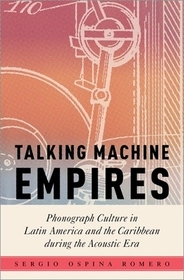
Talking Machine Empires
Phonograph Culture in Latin America and the Caribbean during the Acoustic Era
Series: Critical Conjunctures in Music and Sound;
- Publisher's listprice GBP 68.00
-
30 702 Ft (29 240 Ft + 5% VAT)
The price is estimated because at the time of ordering we do not know what conversion rates will apply to HUF / product currency when the book arrives. In case HUF is weaker, the price increases slightly, in case HUF is stronger, the price goes lower slightly.
- Discount 10% (cc. 3 070 Ft off)
- Discounted price 27 632 Ft (26 316 Ft + 5% VAT)
Subcribe now and take benefit of a favourable price.
Subscribe
30 702 Ft

Availability
Estimated delivery time: In stock at the publisher, but not at Prospero's office. Delivery time approx. 3-5 weeks.
Not in stock at Prospero.
Why don't you give exact delivery time?
Delivery time is estimated on our previous experiences. We give estimations only, because we order from outside Hungary, and the delivery time mainly depends on how quickly the publisher supplies the book. Faster or slower deliveries both happen, but we do our best to supply as quickly as possible.
Product details:
- Publisher OUP USA
- Date of Publication 3 June 2026
- ISBN 9780197686782
- Binding Hardback
- No. of pages304 pages
- Size 243x165x31 mm
- Weight 544 g
- Language English 802
Categories
Short description:
Talking Machine Empires is a cultural and colonial history of the dawn of the sound recording industry in Latin America and the Caribbean in the early twentieth century, before microphones and loudspeakers.
MoreLong description:
At the turn of the twentieth century, sound recording corporations from the United States and Europe pursued repertoires and consumers from all over the world. Latin America and the Caribbean were a crucial part of the puzzle. As a modern imperial age unfolded and these businesses capitalized on old and new colonial maneuvers, phonograph culture thrived and recorded sound became a matter of everyday life. All these processes took place at the intersection of convoluted imperial networks, mundane interactions between corporate delegates and local artists, improvisations in matters of music and technology, emerging economic paradigms, and unprecedented cultural formations mediated by new ideas about modernity and entertainment.
Talking Machine Empires offers a fascinating cultural and colonial history of the dawn of the sound recording industry in Latin America and the Caribbean in the acoustic era, before microphones and loudspeakers. The details in that history reveal unambiguous imperial practices: sending recording expeditions to the realms of the cultural Other, mobilizing performers from one continent to another, taking their labor and talent for granted, extracting sound and natural resources along with material and immaterial culture, and profiting from all of that by virtue of the imbalances of global capitalism and the enduring strength of coloniality. At the same time, it is a history full of intercultural exchanges around and through recorded media, just as it is a history of musical innovation, resistance, and cultural autonomy despite and because of the unevenness of corporate imperialism and the resilience of coloniality.
Using a vast array of primary resources, including original recording ledgers and travelogues, Talking Machine Empires explores not only the swift globalization of recorded sound in the early twentieth century but also the asymmetries that continue to shape the worlds of music and entertainment today.
Table of Contents:
Introduction: Imperialism and Phonograph Culture
Part I. Production
Imperial Networks
Recording Scouts
The Talent Economy
Acoustic Listening
Part II. Circulation and Consumption
Recorded Artifices
Exoticism on Record
The Everyday Life of Recorded Sound
Afterword

