

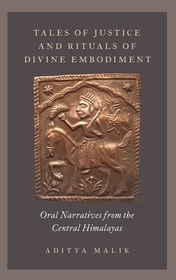
Tales of Justice and Rituals of Divine Embodiment
Oral Narratives from the Central Himalayas
- Publisher's listprice GBP 132.50
-
59 823 Ft (56 975 Ft + 5% VAT)
The price is estimated because at the time of ordering we do not know what conversion rates will apply to HUF / product currency when the book arrives. In case HUF is weaker, the price increases slightly, in case HUF is stronger, the price goes lower slightly.
- Discount 10% (cc. 5 982 Ft off)
- Discounted price 53 841 Ft (51 278 Ft + 5% VAT)
Subcribe now and take benefit of a favourable price.
Subscribe
59 823 Ft

Availability
printed on demand
Why don't you give exact delivery time?
Delivery time is estimated on our previous experiences. We give estimations only, because we order from outside Hungary, and the delivery time mainly depends on how quickly the publisher supplies the book. Faster or slower deliveries both happen, but we do our best to supply as quickly as possible.
Product details:
- Publisher OUP USA
- Date of Publication 7 July 2016
- ISBN 9780199325092
- Binding Hardback
- No. of pages318 pages
- Size 160x236x25 mm
- Weight 573 g
- Language English 0
Categories
Short description:
The result of extensive ethnographic fieldwork into oral narratives, written petitions, stories, and testimonies, Tales of Justice and Rituals of Divine Embodiment from the Central Himalayas explores ideas of justice associated with the worship of the 'God of Justice', Goludev, in the Central Himalayan region Kumaon.
MoreLong description:
Based on extensive ethnographic fieldwork conducted in the Central Himalayan region of Kumaon, Tales of Justice and Rituals of Divine Embodiment from the Central Himalayas explores ideas of justice by drawing on oral and written narratives, stories, testimonies, and rituals told and performed in relation to the 'God of Justice', Goludev, and other regional deities. The book seeks to answer several questions: How is the concept of justice defined in South Asia? Why do devotees seek out Goludev for the resolution of matters of justice instead of using the secular courts? What are the sociological and political consequences of situating divine justice within a secular, democratic, modern context? Moreover, how do human beings locate themselves within the indeterminateness and struggles of their everyday existence? What is the place of language and ritual in creating intimacy and self? How is justice linked to intimacy, truth, and being human?
The stories and narratives in this book revolve around Goludev's own story and deeds, as well as hundreds of petitions (manauti) written on paper that devotees hang on his temple walls, and rituals (jagar) that involve spirit possession and the embodiment of the deity through designated mediums. The jagars are powerful, extraordinary experiences, mesmerizing because of their intensity but also because of what they imply in terms of how we conceptualize being being human with the seemingly limitless potential to shift, alter, and transform ourselves through language and ritual practice. The petitions, though silent and absent of the singing, drumming, and choreography that accompany jagars, are equally powerful because of their candid and intimate testimony to the aspirations, breakdowns, struggles, and breakthroughs that circumscribe human existence.
[an] insightful ethnography ... This book is a welcome addition to the growing literature on possession and healing.
Table of Contents:
List of Illustrations
Acknowledgments
Prologue
Chapter One: The Presence of the Everyday
Chapter Two: Temples, Travels, Territories
Chapter Three: Ideas of Justice
Chapter Four: Writing Intimacy
Chapter Five: Alterity and Modernity
Chapter Six: Transformations
Chapter Seven: Dancers Dancing
Epilogue
Appendix 1: Kalbisht and Gangnath
Appendix 2: Petitions
Notes
References
Index

