

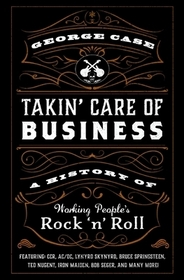
Takin' Care of Business
A History of Working People's Rock 'n' Roll
- Publisher's listprice GBP 27.99
-
13 372 Ft (12 735 Ft + 5% VAT)
The price is estimated because at the time of ordering we do not know what conversion rates will apply to HUF / product currency when the book arrives. In case HUF is weaker, the price increases slightly, in case HUF is stronger, the price goes lower slightly.
- Discount 10% (cc. 1 337 Ft off)
- Discounted price 12 035 Ft (11 462 Ft + 5% VAT)
Subcribe now and take benefit of a favourable price.
Subscribe
13 372 Ft

Availability
Estimated delivery time: In stock at the publisher, but not at Prospero's office. Delivery time approx. 3-5 weeks.
Not in stock at Prospero.
Why don't you give exact delivery time?
Delivery time is estimated on our previous experiences. We give estimations only, because we order from outside Hungary, and the delivery time mainly depends on how quickly the publisher supplies the book. Faster or slower deliveries both happen, but we do our best to supply as quickly as possible.
Product details:
- Publisher OUP USA
- Date of Publication 3 August 2021
- ISBN 9780197548813
- Binding Hardback
- No. of pages216 pages
- Size 157x236x20 mm
- Weight 408 g
- Language English
- Illustrations - 134
Categories
Short description:
In this insightful and timely book, author George Case shows how an important strain of rock music spoke as much to a working-class populist audience as to the rebellious youth audience we typically associate with this music, helping to reset the boundaries of left and right in American society.
MoreLong description:
By the early 1970s, practically everyone under a certain age liked rock music, but not everyone liked it for the same reasons. We typically associate the sounds of classic rock 'n' roll with youthful rebellion by juvenile delinquents, student demonstrators, idealistic hippies, or irreverent punks. But in this insightful and timely book, author George Case shows how an important strain of rock music from the late 1960s onward spoke to ? and represented an idealized self-portrait of ? a very different audience: the working-class 'Average Joes' who didn't want to change the world as much as they wanted to protect their perceived place within it. To the extent that "working-class populism" describes an authentic political current, it's now beyond a doubt that certain musicians and certain of their songs helped define that current.
By now, rock 'n' roll has cast a long shadow over hundreds of millions of people around the world ? not just over reckless kids, but over wage-earning parents and retired elders; not just over indignant youth challenging authority, but over indignant adults challenging their own definition of it. Not only have the politics of rock fans drifted surprisingly rightward since 1970; some rock, as Case argues, has helped reset the very boundaries of left and right themselves. That God, guns, and Old Glory can be understood to be paid fitting tribute in a heavy guitar riff delivered by a long-haired reprobate in blue jeans ? but that
Me Too, Occupy Wall Street or Black Lives Matter might not ? hints at where those boundaries now lie.
Table of Contents:
Introduction: Dream On
Salt of the Earth
Wrote A Song For Everyone
Free For All
Workin' Man Blues
Swamp Music
British Steel
For Those About to Rock
Youngstown
One In a Million
Conclusion: Subdivisions
Further Reading
Notes

