

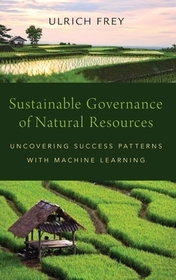
Sustainable Governance of Natural Resources
Uncovering Success Patterns with Machine Learning
- Publisher's listprice GBP 81.00
-
38 697 Ft (36 855 Ft + 5% VAT)
The price is estimated because at the time of ordering we do not know what conversion rates will apply to HUF / product currency when the book arrives. In case HUF is weaker, the price increases slightly, in case HUF is stronger, the price goes lower slightly.
- Discount 10% (cc. 3 870 Ft off)
- Discounted price 34 828 Ft (33 170 Ft + 5% VAT)
Subcribe now and take benefit of a favourable price.
Subscribe
38 697 Ft

Availability
Estimated delivery time: In stock at the publisher, but not at Prospero's office. Delivery time approx. 3-5 weeks.
Not in stock at Prospero.
Why don't you give exact delivery time?
Delivery time is estimated on our previous experiences. We give estimations only, because we order from outside Hungary, and the delivery time mainly depends on how quickly the publisher supplies the book. Faster or slower deliveries both happen, but we do our best to supply as quickly as possible.
Product details:
- Publisher OUP USA
- Date of Publication 17 November 2020
- ISBN 9780197502211
- Binding Hardback
- No. of pages334 pages
- Size 160x241x20 mm
- Weight 590 g
- Language English
- Illustrations 95 63
Categories
Short description:
A comprehensive theoretical synthesis of the various success factors required to successfully and sustainably manage natural resources, Sustainable Governance of Natural Resources offers a quantitative model to predict the success of natural resource management.
MoreLong description:
What can be done to ensure natural resources aren't exploited? Is it possible to determine how to sustainably manage them? What makes some systems successful? In Sustainable Governance of Natural Resources, Ulrich Frey delves deep into unanswered questions like these about resource management. The book explains the current state of biological cooperation mechanisms, case studies in the field, findings from economic-behavioral experiments, common-pool resource dilemmas, and how these are all relevant to these questions surrounding the best way to sustainably manage natural resources.
There are many case studies within the field of social-ecological systems, but there are few large-N studies conducted in a methodologically rigorous manner. Frey does just this and takes readers step-by-step through the preparation of datasets like the CPR, NIIS, and IFRI. He also grounds his research through the development of an indicator system which operationalizes 24 individually-synthesized success factors that influence the management of natural resources. The book reveals the practical and operational uses of measuring ecological success in this way, showcasing various statistical and machine learning methods to develop highly predictive, robust, and empirically-sound models. Three different methods, multivariate linear regressions, random forests, and artificial neural networks are compared to achieve robust results.
The book sheds new light on factors that have previously been investigated, allowing readers to build off of Frey's system and use his methods to determine whether or not their way of managing natural resources will yield ecological success in practice.
It is my hope that others will look at this and be inspired to work with their colleagues to, for example, collect more comparable data with consistent data collection protocols.
Table of Contents:
Acknowledgments
Chapter 1: Introduction
1.1 The high importance of natural resources
1.2 Research question and goals
Chapter 2: State of Research
2.1 What are fundamental biological mechanisms of cooperation?
2.2 What drives cooperation in laboratory experiments?
2.3 Common-pool resources
2.4 A primer on social-ecological systems
2.5 Potential success factors for sustainable management of social-ecological systems
Chapter 3: Data
3.1 Common-pool resource database
3.2 Nepal irrigation institution study database
3.3 International forestry resources and institutions database
3.4 Comparability of databases
3.5 Data preparation
Chapter 4: Methods
4.1 Introducing the three statistical methods used
4.2 Operationalizing the success factors via a new indicator system
Chapter 5: Results and Discussion
5.1 Synthesis of success factors
5.2 Results for the common-pool resource data
5.3 Results for the Nepal irrigation institution study data
5.4 Results for the international forestry resources and institutions data
5.5 Results for a combined full model
5.6 Robustness and sensitivity analyses
Chapter 6: Discussion and Conclusion
6.1 Final assessment
6.2 New findings
6.3 Summary
6.4 Outlook
Chapter 7: Appendix
References
Index

