

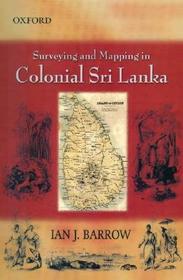
Surveying and Mapping in Colonial Sri Lanka (1800 - 1900)
- Publisher's listprice GBP 16.99
-
7 670 Ft (7 305 Ft + 5% VAT)
The price is estimated because at the time of ordering we do not know what conversion rates will apply to HUF / product currency when the book arrives. In case HUF is weaker, the price increases slightly, in case HUF is stronger, the price goes lower slightly.
- Discount 10% (cc. 767 Ft off)
- Discounted price 6 903 Ft (6 575 Ft + 5% VAT)
Subcribe now and take benefit of a favourable price.
Subscribe
7 670 Ft

Availability
Out of print
Why don't you give exact delivery time?
Delivery time is estimated on our previous experiences. We give estimations only, because we order from outside Hungary, and the delivery time mainly depends on how quickly the publisher supplies the book. Faster or slower deliveries both happen, but we do our best to supply as quickly as possible.
Product details:
- Publisher Oxford University Press
- Date of Publication 7 February 2008
- ISBN 9780195691917
- Binding Hardback
- No. of pages224 pages
- Size 215x136x20 mm
- Weight 439 g
- Language English
- Illustrations 6 maps, 3 plates 0
Categories
Short description:
This is the first in-depth academic work on the Ceylon Survey Department and provides an institutional history of the largest government department on the island. It argues that there was no 'single colonialism' but varieties of colonialism explained by local conditions and exigencies.
MoreLong description:
A study of surveying and mapping is imperative for understanding the nature of colonialism in South Asia. It also sheds light on the islands economy, environment, and politics. This book is the first comprehensive history of surveying and mapping in colonial Sri Lanka. It provides a wide-ranging account of events, policies, and individuals shaping and animating the largest government department on the island.
The volume discusses the founding of the survey department in 1800 and explains why it took them more than one hundred years to publish a map of the island based on new surveys. It also highlights the linkages between the department and the islands ecology and economy and reviews how surveying affected colonial labour practices.
Ian Barrow raises pertinent questions regarding the role of science and modernity in the creation and maintenance of a colonial statewhether there was anything called colonial science? Did the practice of colonial science transform the island into a modern colonial state? He also investigates the nature of nineteenth-century colonialismwhether there were consequential changes in the ideology and practices of colonialism during the century.

