

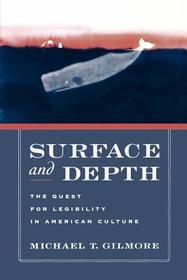
Surface and Depth
The Quest for Legibility in American Culture
- Publisher's listprice GBP 46.99
-
21 215 Ft (20 205 Ft + 5% VAT)
The price is estimated because at the time of ordering we do not know what conversion rates will apply to HUF / product currency when the book arrives. In case HUF is weaker, the price increases slightly, in case HUF is stronger, the price goes lower slightly.
- Discount 10% (cc. 2 121 Ft off)
- Discounted price 19 094 Ft (18 185 Ft + 5% VAT)
Subcribe now and take benefit of a favourable price.
Subscribe
21 215 Ft

Availability
printed on demand
Why don't you give exact delivery time?
Delivery time is estimated on our previous experiences. We give estimations only, because we order from outside Hungary, and the delivery time mainly depends on how quickly the publisher supplies the book. Faster or slower deliveries both happen, but we do our best to supply as quickly as possible.
Product details:
- Publisher OUP USA
- Date of Publication 29 June 2006
- ISBN 9780195313246
- Binding Paperback
- No. of pages256 pages
- Size 230x153x14 mm
- Weight 3 g
- Language English
- Illustrations 1 halftone 0
Categories
Short description:
Surface and Depth offers a fresh interpretation of the unity of American culture. This book focuses on a pervasive zeal for knowing or making things accessible. It traces this compulsion in religion, landscape, politics, and popular entertainment, and explores the complex engagement of American literature with the mandate of legibility.
MoreLong description:
The idea of a common American culture has been in retreat for a generation or more. Arguments emphasizing difference have discredited the grand synthetic studies that marginalized groups and perspectives at odds with the master narrative.
Surface and Depth: The Quest for Legibility in American Culture is a fresh attempt to revitalize an interpretive overview. It seeks to recuperate a central tradition while simultaneously recognizing how much that tradition has occluded. The book focuses on the American zeal for knowing or making accessible. This compulsion has a long history stretching back to Puritan anti-monasticism; to the organization of the landscape into clearly delineated gridwork sections; and to the creation of a national government predicted on popular vigilance. It can be observed in the unmatched American receptivity to the motion pictures and to psychoanalysis: the first a technology of visual surfaces, the second a technique for plumbing interior depths.
Popular literature, especially the Western and the detective story, has reinscribed the cult of legibility. Each genre features a plot that drives through impediments to transparent resolution. Elite literature has adopted a more contradictory stance. The landmarks of the American canon typically embark on journeys of discovery while simultaneously renouncing the possibility of full disclosure (as in Ahab's doomed pursuit of the "inscrutable" white whale). The notorious modernism of American literature, its precocious attraction to obscurity and multiple meaning, evolved as an effort to block the intrusions of a hegemonic cultural dynamic.
The American passion for knowability has been prolific of casualties. Acts of making visible have always entailed the erasure and invisibility of racial minorities. American society has also routinely trespassed on customary areas of reserve. A nation intolerant of the hidden paradoxically pioneered the legal concept of privacy, but it did so in reaction to its own invasive excesses.
"The core of this book is an account of the literary dimensions of legibility, the intersection of the drive to make accessible and known with the literature of the American nation. Michael Gilmore argues his case with precision, bravura, and skill, offering a masterly intervention in the current debate over American literature--revealing, as he does so, an almost encyclopaedic knowledge of contemporary critical discourses, a sophisticated use of relevant cultural theories, and genuine ease with interdisciplinary strategies. Surface and Depth is provocatively poised against the current critical norm, which tends to emphasize plurality and difference. This is a work that, if anything, swims against the disciplinary tide in an effort to get ahead of current critical thinking--and, in my opinion, magnificently succeeds."--Richard Gray, University of Essex

