

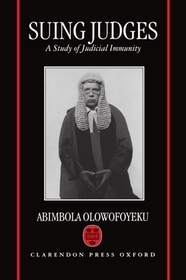
Suing Judges
A Study of Judicial Immunity
- Publisher's listprice GBP 167.50
-
80 023 Ft (76 212 Ft + 5% VAT)
The price is estimated because at the time of ordering we do not know what conversion rates will apply to HUF / product currency when the book arrives. In case HUF is weaker, the price increases slightly, in case HUF is stronger, the price goes lower slightly.
- Discount 10% (cc. 8 002 Ft off)
- Discounted price 72 020 Ft (68 591 Ft + 5% VAT)
Subcribe now and take benefit of a favourable price.
Subscribe
80 023 Ft

Availability
printed on demand
Why don't you give exact delivery time?
Delivery time is estimated on our previous experiences. We give estimations only, because we order from outside Hungary, and the delivery time mainly depends on how quickly the publisher supplies the book. Faster or slower deliveries both happen, but we do our best to supply as quickly as possible.
Product details:
- Publisher Clarendon Press
- Date of Publication 2 December 1993
- ISBN 9780198257936
- Binding Hardback
- No. of pages258 pages
- Size 223x145x20 mm
- Weight 448 g
- Language English 0
Categories
Short description:
When a person is injured by the act of someone else the natural response is to seek redress in the courts. When the person to be sued happens to be a judge, a number of potentially insurmountable obstacles often appear. This is because of the privilege of immunity given to judges. This book presents an in-depth study of the substantive, procedural and theoretical issues that arise when a judge is to be sued. Material is drawn mainly from English and American Federal case law. The study however also incorporates some Canadian, Australian and New Zealand case law.
MoreLong description:
Judicial errors, deliberate or otherwise, often cause damage to litigants. Sometimes the damage suffered by the litigant is irreversible. In England and many other common law countries the injured person will normally have no redress because of the privilege of immunity from suit enjoyed by judges. This result also normally follows when the complaint is against the actions of someone acting in a quasi-judicial capacity. The situation then raises a number of questions, including questions about civil rights, the redress of wrongs, and the whole foundation of judicial independence.
As more people resort to the courts and other judicial tribunals for the resolution of their disputes the question of the proper approach to injurious judicial errors becomes more important, especially since every participant in judicial proceedings is a potential victim. This book presents an in-depth study of the substantive, procedural and theoretical issues that arise when a judge is to be sued. The material is drawn mainly from English and American Federal case law. The study however also incorporates some Canadian, Australian and New Zealand case law.
Intelligent study.'
Stephen Sedley, London Review of Books

