

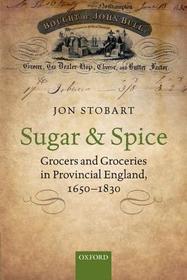
Sugar and Spice
Grocers and Groceries in Provincial England, 1650-1830
- Publisher's listprice GBP 49.99
-
22 570 Ft (21 495 Ft + 5% VAT)
The price is estimated because at the time of ordering we do not know what conversion rates will apply to HUF / product currency when the book arrives. In case HUF is weaker, the price increases slightly, in case HUF is stronger, the price goes lower slightly.
- Discount 10% (cc. 2 257 Ft off)
- Discounted price 20 313 Ft (19 346 Ft + 5% VAT)
Subcribe now and take benefit of a favourable price.
Subscribe
22 570 Ft

Availability
printed on demand
Why don't you give exact delivery time?
Delivery time is estimated on our previous experiences. We give estimations only, because we order from outside Hungary, and the delivery time mainly depends on how quickly the publisher supplies the book. Faster or slower deliveries both happen, but we do our best to supply as quickly as possible.
Product details:
- Publisher OUP Oxford
- Date of Publication 10 November 2016
- ISBN 9780198795964
- Binding Paperback
- No. of pages318 pages
- Size 233x157x17 mm
- Weight 484 g
- Language English 0
Categories
Short description:
Reveals how changes in retailing and shopping were central to the broader transformation of consumption and consumer practices, and questions established ideas about the motivations underpinning consumer choices. Offers new perspectives on the link between supply and demand and the motivations underpinning consumer choices.
MoreLong description:
Consumers in eighteenth-century England were firmly embedded in an expanding world of goods, one that incorporated a range of novel foods (tobacco, chocolate, coffee, and tea) and new supplies of more established commodities, including sugar, spices, and dried fruits. Much has been written about the attraction of these goods, which went from being novelties or expensive luxuries in the mid-seventeenth century to central elements of the British diet a century or so later. They have been linked to the rise of Britain as a commercial and imperial power, whilst their consumption is seen as transforming many aspects of British society and culture, from mealtimes to gender identity. Despite this huge significance to ideas of consumer change, we know remarkably little about the everyday processes through which groceries were sold, bought, and consumed.
In tracing the lines of supply that carried groceries from merchants to consumers, Sugar and Spice reveals not only how changes in retailing and shopping were central to the broader transformation of consumption and consumer practices, but also questions established ideas about the motivations underpinning consumer choices. It demonstrates the dynamic nature of eighteenth-century retailing; the importance of advertisements in promoting sales and shaping consumer perceptions, and the role of groceries in making shopping an everyday activity. At the same time, it shows how both retailers and their customers were influenced by the practicalities and pleasures of consumption. They were active agents in consumer change, shaping their own practices rather than caught up in a single socially-inclusive cultural project such as politeness or respectability.
At a time when the fascination with all aspects of food, from production to consumption, has never been stronger, this is a welcome publication, set to earn a place among the most useful recent books on the history of food.
Table of Contents:
Introduction
Ancient and Modern: The grocery trade in early-modern England
A New World of Goods: Groceries in the long eighteenth century
From Colony to Counter: Networks of supply
Geographies of Selling: The grocery trades in provincial towns
Selling Spaces: Display and storage of groceries
Selling Groceries: Service, credit, and price
Exotic, Empire, or Everyday? Advertising groceries
Baskets of Goods: Customers and shopping practices
Tea and Cakes: Consuming groceries
Cups, Caddies, and Castors: Groceries and domestic material culture
Conclusions
Bibliography

