

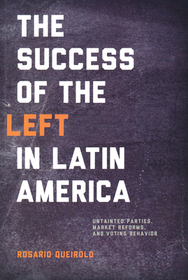
Success of the Left in Latin America
Untainted Parties, Market Reforms, and Voting Behavior
Series: Kellogg Institute Series on Democracy and Development;
- Publisher's listprice GBP 26.99
-
12 185 Ft (11 605 Ft + 5% VAT)
The price is estimated because at the time of ordering we do not know what conversion rates will apply to HUF / product currency when the book arrives. In case HUF is weaker, the price increases slightly, in case HUF is stronger, the price goes lower slightly.
- Discount 20% (cc. 2 437 Ft off)
- Discounted price 9 748 Ft (9 284 Ft + 5% VAT)
- Discount is valid until: 30 June 2026
Subcribe now and take benefit of a favourable price.
Subscribe
12 185 Ft

Availability
printed on demand
Why don't you give exact delivery time?
Delivery time is estimated on our previous experiences. We give estimations only, because we order from outside Hungary, and the delivery time mainly depends on how quickly the publisher supplies the book. Faster or slower deliveries both happen, but we do our best to supply as quickly as possible.
Product details:
- Edition number 1
- Publisher University of Notre Dame Press
- Date of Publication 30 October 2013
- Number of Volumes Print PDF
- ISBN 9780268039790
- Binding Paperback
- No. of pages224 pages
- Size 229x152x12 mm
- Weight 308 g
- Language English
- Illustrations 32 tables, 16 graphs, and 1 map - 16 Line drawings, black and white - 32 Tables, black and white - 1 Maps Line drawings, black & white 0
Categories
Long description:
"
Why, since the beginning of the twenty-first century, have so many Latin American countries elected governments identifying themselves with the ideological Left? In The Success of the Left in Latin America: Untainted Parties, Market Reforms, and Voting Behavior, Rosario Queirolo argues that the ""pink tide"" that swept across Latin America beginning in the late 1990s—with the election of a growing number of leftist political candidates to public office—was caused by the intent of voters to punish political parties unable to improve the economic well-being of their electorates. She argues that Latin Americans vote based on performance, ousting those whom they perceive as responsible for economic downturns, and ushering into power those in the ""untainted opposition,"" which has been the Left in most Latin American countries.
Queirolo argues that the effects of neoliberal economic reforms did not produce more votes for political parties on the Left. Rather, the key variable is unemployment. Left-leaning parties in Latin America increase their electoral chances when unemployment is high. In addition to explaining recent electoral successes of leftist parties, The Success of the Left in Latin America also undermines a dominant scholarly view of Latin Americans as random and unpredictable voters by showing how the electorate at the polls holds politicians accountable.
" More
