

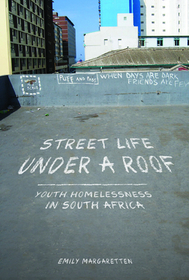
Street Life Under a Roof
Youth Homelessness in South Africa
Series: Interp Culture New Millennium; 64;
- Publisher's listprice GBP 18.99
-
9 072 Ft (8 640 Ft + 5% VAT)
The price is estimated because at the time of ordering we do not know what conversion rates will apply to HUF / product currency when the book arrives. In case HUF is weaker, the price increases slightly, in case HUF is stronger, the price goes lower slightly.
- Discount 10% (cc. 907 Ft off)
- Discounted price 8 165 Ft (7 776 Ft + 5% VAT)
Subcribe now and take benefit of a favourable price.
Subscribe
9 072 Ft

Availability
Estimated delivery time: In stock at the publisher, but not at Prospero's office. Delivery time approx. 3-5 weeks.
Not in stock at Prospero.
Why don't you give exact delivery time?
Delivery time is estimated on our previous experiences. We give estimations only, because we order from outside Hungary, and the delivery time mainly depends on how quickly the publisher supplies the book. Faster or slower deliveries both happen, but we do our best to supply as quickly as possible.
Product details:
- Edition number 1
- Publisher University of Illinois Press
- Date of Publication 8 September 2015
- Number of Volumes Paperback
- ISBN 9780252081118
- Binding Paperback
- See also 9780252039607
- No. of pages232 pages
- Size 229x152x20 mm
- Weight 399 g
- Language English
- Illustrations 12 black and white photographs, 2 MAPS 0
Categories
Long description:
"Point Place stands near the city center of Durban, South Africa. Condemned and off the grid, the five-story apartment building is nonetheless home to a hundred-plus teenagers and young adults marginalized by poverty and chronic unemployment.
In Street Life under a Roof, Emily Margaretten draws on ten years of up-close fieldwork to explore the distinct cultural universe of the Point Place community. Margaretten's sensitive investigations reveal how young men and women draw on customary notions of respect and support to forge an ethos of connection and care that allows them to live far richer lives than ordinarily assumed. Her discussion of gender dynamics highlights terms like nakana--to care about or take notice of another--that young women and men use to construct ""outside"" and ""inside"" boyfriends and girlfriends and to communicate notions of trust. Margaretten exposes the structures of inequality at a local, regional, and global level that contribute to socioeconomic and political dislocation. But she also challenges the idea that Point Place's marginalized residents need ""rehabilitation."" As she argues, these young men and women want love, secure homes, and the means to provide for their dependents--in short, the same hopes and aspirations mirrored across South African society.
" More
