

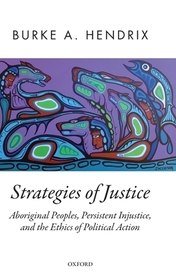
Strategies of Justice
Aboriginal Peoples, Persistent Injustice, and the Ethics of Political Action
Series: Oxford Political Theory;
- Publisher's listprice GBP 65.00
-
29 347 Ft (27 950 Ft + 5% VAT)
The price is estimated because at the time of ordering we do not know what conversion rates will apply to HUF / product currency when the book arrives. In case HUF is weaker, the price increases slightly, in case HUF is stronger, the price goes lower slightly.
- Discount 10% (cc. 2 934 Ft off)
- Discounted price 26 413 Ft (25 155 Ft + 5% VAT)
Subcribe now and take benefit of a favourable price.
Subscribe
29 347 Ft

Availability
printed on demand
Why don't you give exact delivery time?
Delivery time is estimated on our previous experiences. We give estimations only, because we order from outside Hungary, and the delivery time mainly depends on how quickly the publisher supplies the book. Faster or slower deliveries both happen, but we do our best to supply as quickly as possible.
Product details:
- Publisher OUP Oxford
- Date of Publication 8 May 2019
- ISBN 9780198833543
- Binding Hardback
- No. of pages320 pages
- Size 235x159x24 mm
- Weight 626 g
- Language English 0
Categories
Short description:
This volumes argues that it is essential for political theorists to think carefully about the political circumstances of indigenous groups facing persistent injustice, and about the political methods that these groups may adopt in seeking to improve their condition, particularly focusing on indigenous communitities in the US and Canada.
MoreLong description:
Political theorists often imagine themselves as political architects, asking what an ideal set of laws or social structures might look like. Yet persistent injustices can endure for decades or even centuries despite such ideal theorizing. In circumstances of this kind, it is essential for political theorists to think carefully about the political choices available to those who directly face such injustices and seek to change them.
This book focuses on the claims of Aboriginal peoples to better treatment from the United States and Canada. Though other groups face similarly persistent injustices (e.g. African Americans in the United States), the specific details of injustice matter a great deal for its analysis. The book focuses on two intertwined issues: the kinds of moral permissions that those facing persistent injustice have when they act politically, and the kinds of transformations that political action may bring about in those who undertake it. The book argues for normative permissions to speak untruth to power; to circumvent or nullify existing law; to give primary attention to protecting one's own community first; and to engage in political experimentation that reshapes future generations. When carefully used, the book argues, these permissions may help political actors to avoid co-optation and self-delusion. At the same time, divisions of labor between those who grapple most closely with state institutions and those who keep their distance may be necessary to facilitate escape from persistent injustice over the long term.
Oxford Political Theory presents the best new work in contemporary political theory. It is intended to be broad in scope, including original contributions to political philosophy, and also work in applied political theory. The series will contain works of outstanding quality with no restriction as to approach or subject matter. Series Editors: Will Kymlicka and David Miller.
Table of Contents:
Introduction: Word Warriors and Political Action
The Ethics of Political Action
Deliberation and Political Strategy
Justified Lawbreaking
Self-Care and Proportionality
Envisioning the Future
Conclusion: Political Philosophy and Political Change

