

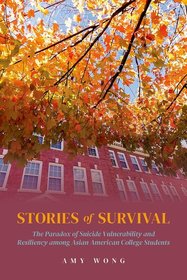
Stories of Survival
The Paradox of Suicide Vulnerability and Resiliency among Asian American College Students
- Publisher's listprice GBP 23.99
-
11 461 Ft (10 915 Ft + 5% VAT)
The price is estimated because at the time of ordering we do not know what conversion rates will apply to HUF / product currency when the book arrives. In case HUF is weaker, the price increases slightly, in case HUF is stronger, the price goes lower slightly.
- Discount 10% (cc. 1 146 Ft off)
- Discounted price 10 315 Ft (9 824 Ft + 5% VAT)
Subcribe now and take benefit of a favourable price.
Subscribe
11 461 Ft

Availability
Estimated delivery time: In stock at the publisher, but not at Prospero's office. Delivery time approx. 3-5 weeks.
Not in stock at Prospero.
Why don't you give exact delivery time?
Delivery time is estimated on our previous experiences. We give estimations only, because we order from outside Hungary, and the delivery time mainly depends on how quickly the publisher supplies the book. Faster or slower deliveries both happen, but we do our best to supply as quickly as possible.
Product details:
- Publisher OUP USA
- Date of Publication 12 September 2023
- ISBN 9780197662397
- Binding Paperback
- No. of pages256 pages
- Size 142x211x15 mm
- Weight 308 g
- Language English 445
Categories
Short description:
Stories of Survival explores the paradox of suicide vulnerability and resiliency among Asian American college students and how to improve care for this frequently overlooked population in mental health research.
MoreLong description:
College suicides are a growing social problem in the United States. Suicide is the second leading cause of death on university campuses and more than half of all college students report experiencing some level of suicide ideation in their lifetime. Asian American students are particularly vulnerable to suicide ideation, yet these students also show strong resiliency, leading to lower rates of suicide deaths than their peers.
Stories of Survival explores the paradox of suicide vulnerability and resiliency among Asian American college students using one-on-one interviews collected during the global pandemic. This narrative research uses a strength-based approach to understand how Asian American college students live with their suicidal tendencies. It offers a deeply felt examination of the history of mental health challenges that the Asian American undergraduate population face—from intergenerational trauma to racial microaggressions—and the coping strategies, protective factors, and life skills these students build to develop resiliency and well-being. Finally, Stories of Survival ends with practical recommendations and a call to action for colleges and universities to address this important and urgent mental health crisis.
Stories of Survival shines a critical light on a frequently overlooked population in mental health research and the ways we can improve resiliency among our most vulnerable communities.
Table of Contents:
Dedication
Acknowledgements
Preface
Introduction
Chapter 1: The Risk Factors for Suicide Ideation
History of Mental Health Challenges
"Today is a Bad Day"
Intergenerational Trauma
Thwarted Belongingness
Perceived Burdensomeness
Ongoing Suicidal Thoughts
Chapter 2: The Protective Factors against Suicide Death
The Global Pandemic
Coping Strategies and Self-Reliance
Support Systems and Human Attachment
Life Skills and Self-Care
"Today is a Good Day"
Reasons for Living
Chapter 3: Addressing the Paradox of Suicide Vulnerability and Resiliency
Understanding Vulnerability and Reducing Risk Factors
Understanding Resiliency and Promoting Protective Factors
The Call for Action
Practice Recommendations
Research Recommendations
Conclusion
Afterword
References
Index

