

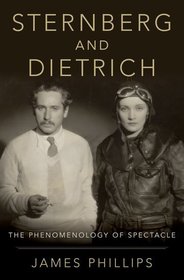
Sternberg and Dietrich
The Phenomenology of Spectacle
- Publisher's listprice GBP 72.00
-
32 508 Ft (30 960 Ft + 5% VAT)
The price is estimated because at the time of ordering we do not know what conversion rates will apply to HUF / product currency when the book arrives. In case HUF is weaker, the price increases slightly, in case HUF is stronger, the price goes lower slightly.
- Discount 10% (cc. 3 251 Ft off)
- Discounted price 29 257 Ft (27 864 Ft + 5% VAT)
Subcribe now and take benefit of a favourable price.
Subscribe
32 508 Ft

Availability
Estimated delivery time: In stock at the publisher, but not at Prospero's office. Delivery time approx. 3-5 weeks.
Not in stock at Prospero.
Why don't you give exact delivery time?
Delivery time is estimated on our previous experiences. We give estimations only, because we order from outside Hungary, and the delivery time mainly depends on how quickly the publisher supplies the book. Faster or slower deliveries both happen, but we do our best to supply as quickly as possible.
Product details:
- Publisher OUP USA
- Date of Publication 21 March 2019
- ISBN 9780190915247
- Binding Hardback
- No. of pages136 pages
- Size 239x155x17 mm
- Weight 363 g
- Language English
- Illustrations 9 illustrations 0
Categories
Short description:
Sternberg and Dietrich: The Phenomenology of Spectacle explores the philosophical questions broached by the films Josef von Sternberg and Marlene Dietrich made together at Paramount in the early 1930s. These are films that rethink faith, appearance, the image of women, the treatment of history and the sense of the world.
MoreLong description:
James Phillips's Sternberg and Dietrich: The Phenomenology of Spectacle reappraises the cinematic collaboration between the Austrian-American filmmaker Josef von Sternberg (1894-1969) and the German-American actor Marlene Dietrich (1901-92). Considered by his contemporaries one of the most significant directors of interwar Hollywood, Sternberg made seven films with Dietrich that helped establish her as a style icon and star and entrenched his own reputation for extravagance and aesthetic spectacle. These films enriched the technical repertoire of the industry, challenged the sexual mores of the times and notoriously tried the patience of management at Paramount Studios. Sternberg and Dietrich: The Phenomenology of Spectacle demonstrates how under Sternberg's direction Paramount's sound stages became laboratories for novel thought experiments. Analysing in depth the last four films on which Sternberg and Dietrich worked together, Phillips reconstructs the "cinematic philosophy" that Sternberg claimed for himself in his autobiography and for whose fullest expression Dietrich was indispensable. This book makes a case for the originality and perceptiveness with which these films treat such issues as the nature of trust, the status of appearance, the standing of women, the ethics and politics of the image, and the relationship between cinema and the world. Sternberg and Dietrich: The Phenomenology of Spectacle reveals that more is at stake in these films than the showcasing of a new star and the confectionery of glamour: Dietrich emerges here as a woman who is at ease in the world without being at home in it, an image of autonomy whose critical potential has yet to be realized, let alone exhausted.
While Phillips's starting point and purpose may be philosophical, Sternberg and Dietrich is genuinely, and imaginatively, engaged with the films under consideration, with their maker and their star, excavating the progress and the structure of its own pleasure and fascination-- and ours. This absorbing book thinks afresh about the experience of cinematic perception, about spectacle and spectatorship, the agency of images, the auteur's voice, the aura of stars. Phillips invites us to re-examine these ideas not in academic isolation but, to borrow his phrase, within the horizon of human interaction.
Table of Contents:
Introduction: Dietrich's Face and the Talking Picture
1. Shanghai Express: Making Room for Faith in Appearances
2. Blonde Venus: A Sale of Two Bodies
3. The Scarlet Empress: History as Farce
4. The Devil Is a Woman: Against the Off-Screen
Conclusion: Towards an Ethics of the Moving Image
Notes
Index

