

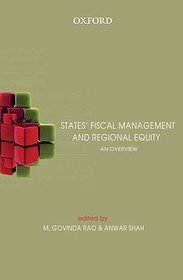
States' Fiscal Management and Regional Equity
An Overview
- Publisher's listprice GBP 25.99
-
12 416 Ft (11 825 Ft + 5% VAT)
The price is estimated because at the time of ordering we do not know what conversion rates will apply to HUF / product currency when the book arrives. In case HUF is weaker, the price increases slightly, in case HUF is stronger, the price goes lower slightly.
- Discount 10% (cc. 1 242 Ft off)
- Discounted price 11 175 Ft (10 643 Ft + 5% VAT)
Subcribe now and take benefit of a favourable price.
Subscribe
12 416 Ft

Availability
Uncertain availability. Please turn to our customer service.
Why don't you give exact delivery time?
Delivery time is estimated on our previous experiences. We give estimations only, because we order from outside Hungary, and the delivery time mainly depends on how quickly the publisher supplies the book. Faster or slower deliveries both happen, but we do our best to supply as quickly as possible.
Product details:
- Publisher OUP India
- Date of Publication 16 July 2009
- ISBN 9780195698794
- Binding Hardback
- No. of pages308 pages
- Size 224x148x23 mm
- Weight 488 g
- Language English
- Illustrations tables and figures 0
Categories
Short description:
This book deals with important aspects of State level fiscal management in India. It analyses the state finances focusing on the creation of an enabling environment for balanced regional development in the country.
MoreLong description:
The states in India have a predominant role in advancing human development and a co-equal role with the central government in the provision of economic services. The condition of states' fiscal health, therefore, determines both the nature and quality of economic growth in the country.
With contributions from leading fiscal experts, this volume presents an overview of the challenges of fiscal management faced by states and the national challenge of regional fiscal equity. It addresses a variety of issues related to state finances, regional developmental policies, and the design and implementation of intergovernmental transfers, including the National Rural Employment Guarantee Act.
Using the latest data on federal-state finances, the essays analyse the impact of fiscal policies and institutions on inter-state disparities. Ironically, the states that are rich in resources are the least developed- while their resources are exploited for national benefit, they themselves have lagged behind due to inadequate compensation. The volume argues that realizing the developmental potential of the country will depend upon the fiscal management by the centre to create a common
market and enable a level playing field for lagging states. Equally important is the latter's own efforts at raising revenues and efficiently managing resources.
Addressing important policy concerns for ensuring sustainable and inclusive growth, this volume is an important contribution in the area of federal finance. It will be useful for students and researchers in the fields of public finance and development economics, policymakers, NGOs, and development agencies
Table of Contents:
States' Fiscal Management and Regional Equity: An Overview;
. Recent Trends in State Finances;
Reforming the State Tax System in a Globalizing Environment;
Debt Management in States: Emerging Issues;
Anti-Poverty Interventions in a Cooperative Federalism;
Reform of Intergovernmental Fiscal Arrangements for Balanced Regional Development;
Resource Endowment, Fiscal Flows and Regional Equity in Indian Federalism;
Regional Disparities in infrastructure and urban service delivery;
Regional Development Policies and Regional Inequality in India;

