

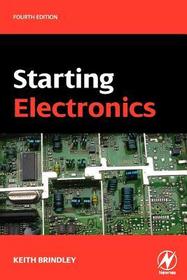
Starting Electronics
- Publisher's listprice EUR 24.95
-
10 348 Ft (9 855 Ft + 5% VAT)
The price is estimated because at the time of ordering we do not know what conversion rates will apply to HUF / product currency when the book arrives. In case HUF is weaker, the price increases slightly, in case HUF is stronger, the price goes lower slightly.
- Discount 10% (cc. 1 035 Ft off)
- Discounted price 9 313 Ft (8 870 Ft + 5% VAT)
Subcribe now and take benefit of a favourable price.
Subscribe
10 348 Ft

Availability
printed on demand
Why don't you give exact delivery time?
Delivery time is estimated on our previous experiences. We give estimations only, because we order from outside Hungary, and the delivery time mainly depends on how quickly the publisher supplies the book. Faster or slower deliveries both happen, but we do our best to supply as quickly as possible.
Product details:
- Edition number 4
- Publisher Elsevier Science
- Date of Publication 2 August 2011
- ISBN 9780080969923
- Binding Paperback
- No. of pages296 pages
- Size 228x152 mm
- Weight 480 g
- Language English 0
Categories
Long description:
Starting Electronics is unrivalled as a highly practical introduction for technicians, non-electronic engineers, software engineers, students, and hobbyists. Keith Brindley introduces readers to the functions of the main component types, their uses, and the basic principles of building and designing electronic circuits. Breadboard layouts make this very much a ready-to-run book for the experimenter, and the use of readily available, inexpensive components makes this practical exploration of electronics easily accessible to all levels of engineer and hobbyist.
Other books tell readers what to do, but sometimes fail to explain why - Brindley gives readers hands-on confidence in addition to real scientific knowledge, and insight into the principles as well as the practice. All written explanations and steps are supplemented with numerous photos, charts, tables and graphs. Concepts and practical aspects are explained thoroughly with mathematical formulae and technical schematic drawings.
Each chapter introduces a concept or tool, explains the basic theory, and provides clear instructions for a simple experiment to apply the concept or tool, with quiz sections and answers, at the end of each chapter. New chapters on multimeters and soldering will be added, covering the fundamentals and experiments, with a basic parts list and an expanded and updated buyer's guide.
MoreTable of Contents:
1. The very first steps2. On the boards3. Measuring current and voltage4. Capacitors5. ICs, oscillators and filters6. Diodes I7. Diodes II8. Transistors9. Analogue integrated circuits10. Digital integrated circuits I11. Digital integrated circuits II12. Soldering
More
