

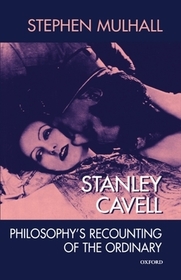
Stanley Cavell
Philosophy's Recounting of the Ordinary
- Publisher's listprice GBP 63.00
-
28 444 Ft (27 090 Ft + 5% VAT)
The price is estimated because at the time of ordering we do not know what conversion rates will apply to HUF / product currency when the book arrives. In case HUF is weaker, the price increases slightly, in case HUF is stronger, the price goes lower slightly.
- Discount 10% (cc. 2 844 Ft off)
- Discounted price 25 600 Ft (24 381 Ft + 5% VAT)
Subcribe now and take benefit of a favourable price.
Subscribe
28 444 Ft

Availability
printed on demand
Why don't you give exact delivery time?
Delivery time is estimated on our previous experiences. We give estimations only, because we order from outside Hungary, and the delivery time mainly depends on how quickly the publisher supplies the book. Faster or slower deliveries both happen, but we do our best to supply as quickly as possible.
Product details:
- Publisher OUP Oxford
- Date of Publication 7 January 1999
- ISBN 9780198238508
- Binding Paperback
- No. of pages378 pages
- Size 215x138x21 mm
- Weight 475 g
- Language English 0
Categories
Short description:
Stephen Mulhall presents the first full philosophical study of the work of Stanley Cavell. Cavell, a leading contemporary American thinker, is best known for his highly influential contributions to the fields of film studies, Shakespearian literary criticism, and the confluence of psychoanalysis and literary theory; Mulhall examines the broad spectrum of his thought, elucidating its essentially philosophical roots and trajectory.
MoreLong description:
Stephen Mulhall presents the first full-length philosophical study of the work of Stanley Cavell, best known for his highly influential contributions to the fields of film studies, Shakespearian literary criticism, and the confluence of psychoanalysis and literary theory. It is not properly appreciated that Cavell's project originated in his interpretation of Austin's and Wittgenstein's philosophical interest in the criteria governing ordinary language, and is given unity by an abiding concern with the nature and the varying cultural manifestations of the sceptical impulse in modernity. This book elucidates the essentially philosophical roots and trajectory of Cavell's work, traces its links with Romanticism and its recent turn towards a species of moral pefectionism associated with Thoreau and Emerson, and concludes with an assessment of its relations to liberal-democratic political theory, Christian religious thought, and feminist literary studies. It will be of interest to anyone concerned with the relationships between Anglo-American and Continental philosophy, and between philosophy and other disciplines in the humanities.
'an excellent presentation and discussion of [Cavell's] thought . . . very timely' Political Studies
'Learning to read Mulhall is both a suitable and a worthy first step to learning to read Cavell' British Journal of Aesthetics
'there can be no doubt as to the depth of Mulhall's knowledge of Cavell's writings or to his ability as an advocate. [The book] is also very well written. Mulhall's prose is capable of registering the fine grain in a subtle and elusive thinker and, while more conventional than Cavell's, is no less supple or eloquent.' Times Literary Supplement
'[Mulhall's] explication is careful enough to explain the importance of Cavell's work, clarify the subtleties of Cavell's ideas, provide a complete overview of Cavell's thought, and show the coherence in Cavell's diverse writings . . .invaluable' Harvard Review
Despite what his book's title might suggest, Stephen Mulhall's thorough explication of Stanley Cavell's philosophy is anything but ordinary. At the outset Mulhall makes it clear that he intends to address Cavell's exceptional formidability, and set himself `not to attempt to do what can and must only be done by Cavell's own prose, but to clear the space that is required for it to do so'....to Mulhall's credit...he has cleared the space for such a return.
Table of Contents:
Introduction: On Saying What We Mean
PART I: PATTERNS, AGREEMENT, AND RATIONALITY
Aesthetics: Hume, Kant, and Criticism
Morality: Emotivism and Agreement
Politics: The Social Contract
PART II: CRITERIA, SCEPTICISM, AND ROMANTICISM
Criteria, Scepticism, and the External World
Criteria, Scepticism, and Other Minds
Criteria, Counting, and Recounting
PART III: COMMON THEMES, COMPETING PERSPECTIVES
Introduction: Redemptive Reading: Refractions and Reflexivities
Shakespeare: Scepticism and Tragedy
Psychoanalysis: Practices of Recovery
Cinema: Photography, Comedy, Melodrama
PART IV: PHILOSOPHY, PEFECTIONISM, AND RELIGION
Thoreau: Writing, Mourning, Neighbouring
Emerson; Perfectionism, Idiosyncrasy, Justice
`Philosophy Cannot Say Sin'
Postscript: Philosophy's Closet
Bibliography
Index

