

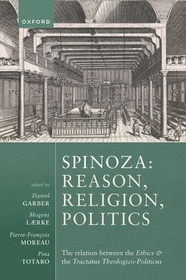
Spinoza: Reason, Religion, Politics
The relation between the Ethics and the Tractatus Theologico-Politicus
- Publisher's listprice GBP 117.50
-
53 051 Ft (50 525 Ft + 5% VAT)
The price is estimated because at the time of ordering we do not know what conversion rates will apply to HUF / product currency when the book arrives. In case HUF is weaker, the price increases slightly, in case HUF is stronger, the price goes lower slightly.
- Discount 10% (cc. 5 305 Ft off)
- Discounted price 47 746 Ft (45 473 Ft + 5% VAT)
Subcribe now and take benefit of a favourable price.
Subscribe
53 051 Ft

Availability
Estimated delivery time: In stock at the publisher, but not at Prospero's office. Delivery time approx. 3-5 weeks.
Not in stock at Prospero.
Why don't you give exact delivery time?
Delivery time is estimated on our previous experiences. We give estimations only, because we order from outside Hungary, and the delivery time mainly depends on how quickly the publisher supplies the book. Faster or slower deliveries both happen, but we do our best to supply as quickly as possible.
Product details:
- Publisher OUP Oxford
- Date of Publication 5 September 2024
- ISBN 9780198848165
- Binding Hardback
- No. of pages480 pages
- Size 240x164x31 mm
- Weight 868 g
- Language English 518
Categories
Short description:
In Spinoza: Reason, Religion, Politics, a diverse international group of scholars explore Spinoza's two major works Ethics, and Tractatus theologico-politicus. The essays confront both of these works together, and attempt to understand the ways in which they are related to one another.
MoreLong description:
At his death, Spinoza left two major works, very different from one another. The first is the Ethics, rigorously set out in geometrical terms, with definitions, axioms, and theorems. In the Ethics, Spinoza takes the reader down the path of reason to an ultimate beatitude, a rational salvation, a kind of peace of mind attained through the true knowledge of God, oneself, and one's place in the world. The other is of a very different sort. The Tractatus theologico-politicus is set out in twenty chapters. It begins with a discussion of prophecy and revelation, followed by a detailed description of Scripture, and what we can learn from it, the message of scripture. And that message is to be obedient to God, and to love our neighbours as ourselves.
Two books, two styles of argument, two very different paths to salvation, arguably two Gods and arguably two very different kinds of kinds of salvation at the end. But one author. The challenge is evident: how do these books fit together? One is about reason, the other about revelation, one is about personal salvation, the other more focused on how we live together. Spinoza's writing has always drawn strong reactions, both positive and negative: he was accepted by some as a kind of secular prophet offering us a guide to life, and rejected by others as a kind of atheist and heretic. In this book, a diverse international group of seventeen scholars confronts these two central works in the philosophical canon, and explores what Spinoza is trying to tell us about life, the world, and our place in it.
Table of Contents:
Abbreviations
Introduction
Part One: Two Intertwined Texts
Parallel Masterpieces: Intertextuality in Spinoza's Ethics and Tractatus Theologico-Politicus
Continuity and Discontinuity Between the Tractatus Theologico-Politicus and the Ethics
Spinoza's 'Atheism', the Ethics and the Tractatus Theologico-Politicus
Part Two: God and Atheism
Prejudices, Common Notions, Intuitions: Knowledge of God between the Ethics and the Tractatus Theologico-Politicus
Spinoza's 'Atheism', the Ethics and the Tractatus Theologico-Politicus
Part Three: Laws: Natural, Human, and Divine
Descartes and Spinoza on the Laws of Nature
Divine Law in Spinoza's Tractatus Theologico-Politicus
Divine Law and the Right Way of Living: From the Tractatus Theologico-Politicus to the Ethics
Part Four: Wonder, Final Causes, and Miracles
Is Wonder a Remedy against the Passions? Spinoza's Struggle with Descartes's Legacy in the Tractatus Theologico-Politicus and in the Ethics
Finalism, Religion, and Miracles: From the Tractatus Theologico-Politicus to the Ethics
Part Five: Revelation, Reason, and Salvation
Spinoza's Views on Prophecy and the Prophets Revisited
Philosophy and Theology, Reason and Revelation: the Ethics and the Tractatus Theologico-Politicus
Reason and Scripture in the Ethics and Tractatus Theologico-Politicus: Jarig Jelles and Preface to the Nagelate schriften van B.D.S (1677)
Finding Oneself in God: Scientia Intuitiva as a Metaphysically Self-Locating Thought
How to Make a Philosopher
Part Six: Political Philosophy
Will, Sovereignty, and the Self in the Ethics and the Tractatus Theologico-Politicus
Where is the Collective Morality in Spinoza's Ethics? Connecting Spinoza's Ethics to his Political Philosophy

