

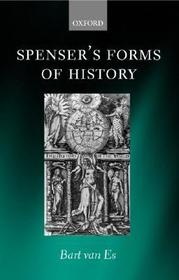
Spenser's Forms of History
- Publisher's listprice GBP 147.50
-
70 468 Ft (67 112 Ft + 5% VAT)
The price is estimated because at the time of ordering we do not know what conversion rates will apply to HUF / product currency when the book arrives. In case HUF is weaker, the price increases slightly, in case HUF is stronger, the price goes lower slightly.
- Discount 10% (cc. 7 047 Ft off)
- Discounted price 63 421 Ft (60 401 Ft + 5% VAT)
Subcribe now and take benefit of a favourable price.
Subscribe
70 468 Ft

Availability
printed on demand
Why don't you give exact delivery time?
Delivery time is estimated on our previous experiences. We give estimations only, because we order from outside Hungary, and the delivery time mainly depends on how quickly the publisher supplies the book. Faster or slower deliveries both happen, but we do our best to supply as quickly as possible.
Product details:
- Publisher OUP Oxford
- Date of Publication 26 September 2002
- ISBN 9780199249701
- Binding Hardback
- No. of pages244 pages
- Size 223x146x18 mm
- Weight 398 g
- Language English 0
Categories
Short description:
In Spenser's Forms of History, Bart Van Es presents an engaging study of the ways in which Edmund Spenser utilized a number of 'forms of history' - chronicle, antiquarian discourse, secular typology, political prophecy, and others - in both his poetry and his prose, and assesses their collective impact on Elizabethan poetry.
MoreLong description:
In Spenser's Forms of History, Bart van Es describes six modes through which Early Modern England addressed the past: chronicle, chorography, antiquarian discourse, euhemerism, typology, and prophecy. By setting this material alongside the works of Edmund Spenser, the book explores allusive strategies ranging in effect from euology to polemic. Key Spenserian texts, including The Faerie Queene, The Shepeardes Calendar, and A View of the Present State of Ireland, are read against Elizabethan cultural documents extending from popular print to restricted manuscripts. Over the course of six chapters, each focusing on a single 'form', the book shows Spenser to have been an exceptional historical thinker. Drawing on recent studies of nationhood, the study not only offers a new picture of the English 'Poet Historical', but also makes an innovative contribution to current debates concerning the relationship between literature and history.
Essential for all Spenserians, Bart van Es's book has much to recommend it to students of early modern Britain.
Table of Contents:
List of Abbreviations
Introduction
Chronicle and Missing History
Chorography and the Presence of the Past
Antiquarianism and Ireland's Conquest
Euhemerism and Universal History
Analogy and History in the Public Sphere
Prophecy and History
Conclusion
Bibliography
Index

