

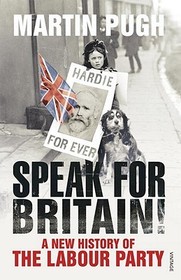
Speak for Britain!
A New History of the Labour Party
-
GET 20% OFF
- Publisher's listprice GBP 13.99
-
6 316 Ft (6 015 Ft + 5% VAT)
The price is estimated because at the time of ordering we do not know what conversion rates will apply to HUF / product currency when the book arrives. In case HUF is weaker, the price increases slightly, in case HUF is stronger, the price goes lower slightly.
- Discount 20% (cc. 1 263 Ft off)
- Discounted price 5 053 Ft (4 812 Ft + 5% VAT)
- Discount is valid until: 31 August 2026
5 053 Ft

Availability
Uncertain availability. Please turn to our customer service.
Why don't you give exact delivery time?
Delivery time is estimated on our previous experiences. We give estimations only, because we order from outside Hungary, and the delivery time mainly depends on how quickly the publisher supplies the book. Faster or slower deliveries both happen, but we do our best to supply as quickly as possible.
Product details:
- Publisher Vintage
- Date of Publication 2 May 2011
- Number of Volumes B-format paperback
- ISBN 9780099520788
- Binding Paperback
- See also 9781847920089
- No. of pages464 pages
- Size 198x129x29 mm
- Weight 342 g
- Language English 0
Categories
Long description:
Written at a critical juncture in the history of the Labour Party, Speak for Britain! is a thought-provoking and highly original interpretation of the party's evolution, from its trade union origins to its status as a national governing party. It charts Labour's rise to power by re-examining the impact of the First World War, the general strike of 1926, Labour's breakthrough at the 1945 general election, the influence of post-war affluence and consumerism on the fortunes and character of the party, and its revival after the defeats of the Thatcher era.
Controversially, Pugh argues that Labour never entirely succeeded in becoming 'the party of the working class'; many of its influential recruits - from Oswald Mosley to Hugh Gaitskell to Tony Blair - were from middle and upper-class Conservative backgrounds and rather than converting the working class to socialism, Labour adapted itself to local and regional political cultures.

