

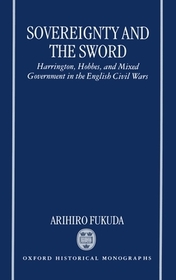
Sovereignty and the Sword
Harrington, Hobbes, and Mixed Government in the English Civil Wars
Series: Oxford Historical Monographs;
- Publisher's listprice GBP 192.50
-
86 913 Ft (82 775 Ft + 5% VAT)
The price is estimated because at the time of ordering we do not know what conversion rates will apply to HUF / product currency when the book arrives. In case HUF is weaker, the price increases slightly, in case HUF is stronger, the price goes lower slightly.
- Discount 10% (cc. 8 691 Ft off)
- Discounted price 78 222 Ft (74 498 Ft + 5% VAT)
Subcribe now and take benefit of a favourable price.
Subscribe
86 913 Ft

Availability
printed on demand
Why don't you give exact delivery time?
Delivery time is estimated on our previous experiences. We give estimations only, because we order from outside Hungary, and the delivery time mainly depends on how quickly the publisher supplies the book. Faster or slower deliveries both happen, but we do our best to supply as quickly as possible.
Product details:
- Publisher OUP Oxford
- Date of Publication 16 October 1997
- ISBN 9780198206835
- Binding Hardback
- No. of pages188 pages
- Size 225x145x16 mm
- Weight 388 g
- Language English 0
Categories
Short description:
This book places the political thought of mid-seventeenth-century England within the context of the English civil wars and offers fresh insights into the principles on which two of the great figures of political thought, Thomas Hobbes and James Harrington, constructed their main arguments. Arihiro Fukuda shows Harrington to have been, no less than Hobbes, a theorist of absolute sovereignty. But where Hobbes repudiated the mixed governments of classical antiquity, Harrington's study of them convinced him that mixed government, far from being the enemy of absolute sovereignty, was its essential foundation. Fukuda shows how Harrington, in recasting Hobbes' thought, achieved an originality and profundity as striking as those of his rival.
MoreLong description:
The English civil wars of the mid-seventeenth century produced two political thinkers of genius: Thomas Hobbes and James Harrington. They are known today as spokesmen of opposite positions, Hobbes of absolutism, Harrington of republicanism. Yet behind their disagreements, argues Arihiro Fukuda, there lay a common perspective. For both writers, the primary aim was the restoration of peace and order to a divided land. Both men saw the conventional thinking of the time as unequal to that task. Their greatest works -- Hobbes's Leviathan of 1651, Harrington's Oceana of 1656 -- proposed the reconstruction of the English polity on novel bases. It was not over the principle of sovereignty that the two men differed. Fukuda shows Harrington to have been, no less than Hobbes, a theorist of absolute sovereignty. But where Hobbes repudiated the mixed governments of classical antiquity, Harrington's study of them convinced him that mixed government, far from being the enemy of absolute sovereignty, was its essential foundation.
this slim but muscular study. ... an analysis of unusual elegance and power.

