

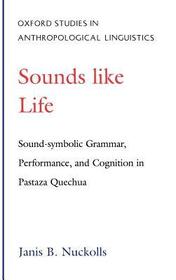
Sounds Like Life
Sound-symbolic Grammar, Performance, and Cognition in Pastaza Quechua
Series: Oxford Studies in Anthropological Linguistics; 2;
- Publisher's listprice GBP 65.00
-
29 347 Ft (27 950 Ft + 5% VAT)
The price is estimated because at the time of ordering we do not know what conversion rates will apply to HUF / product currency when the book arrives. In case HUF is weaker, the price increases slightly, in case HUF is stronger, the price goes lower slightly.
- Discount 10% (cc. 2 934 Ft off)
- Discounted price 26 413 Ft (25 155 Ft + 5% VAT)
Subcribe now and take benefit of a favourable price.
Subscribe
29 347 Ft

Availability
printed on demand
Why don't you give exact delivery time?
Delivery time is estimated on our previous experiences. We give estimations only, because we order from outside Hungary, and the delivery time mainly depends on how quickly the publisher supplies the book. Faster or slower deliveries both happen, but we do our best to supply as quickly as possible.
Product details:
- Publisher OUP USA
- Date of Publication 19 September 1996
- ISBN 9780195089851
- Binding Hardback
- No. of pages312 pages
- Size 244x163x29 mm
- Weight 635 g
- Language English
- Illustrations line drawings 0
Categories
Short description:
Nuckolls studies the occurrence of sound-symbolic words - words that bear resemblance to phenomena they attempt to describe - in an Ecuadorian dialect of Quechua, a major South American language. She explores how the speakers describe everyday experience and how sound-symbolism is integral to their way of thinking and speaking.
MoreLong description:
Nuckolls studies the occurrence of sound-symbolic words - words that bear resemblance to phenomena they attempt to describe - in an Ecuadorian dialect of Quechua, a major South American language. She explores how the speakers describe everyday experience and how sound-symbolism is integral to their way of thinking and speaking.
The book speaks for the value of intensively conducted linguistic field research, evocatively encourages our reassessments of dichotomic theories about language, and will doubtless occupy quite a unique place on the shelves of Quechua studies for some years to come.

