

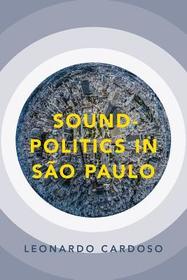
Sound-Politics in São Paulo
Series: Currents in Latin American and Iberian Music;
- Publisher's listprice GBP 38.99
-
17 603 Ft (16 765 Ft + 5% VAT)
The price is estimated because at the time of ordering we do not know what conversion rates will apply to HUF / product currency when the book arrives. In case HUF is weaker, the price increases slightly, in case HUF is stronger, the price goes lower slightly.
- Discount 10% (cc. 1 760 Ft off)
- Discounted price 15 843 Ft (15 089 Ft + 5% VAT)
Subcribe now and take benefit of a favourable price.
Subscribe
17 603 Ft

Availability
Estimated delivery time: In stock at the publisher, but not at Prospero's office. Delivery time approx. 3-5 weeks.
Not in stock at Prospero.
Why don't you give exact delivery time?
Delivery time is estimated on our previous experiences. We give estimations only, because we order from outside Hungary, and the delivery time mainly depends on how quickly the publisher supplies the book. Faster or slower deliveries both happen, but we do our best to supply as quickly as possible.
Product details:
- Publisher OUP USA
- Date of Publication 20 June 2019
- ISBN 9780190660109
- Binding Paperback
- No. of pages264 pages
- Size 239x157x25 mm
- Weight 431 g
- Language English 0
Categories
Short description:
In São Paulo during Brazil's post-dictatorship period, noise control became a recurrent controversy, and the ecological agenda against noise as a harmful pollutant has significantly reconfigured the presence of environmental sounds in the city. Sound-Politics in São Paulo argues that the framing of specific sounds as unavoidable, unnecessary, or as harmful "noise" has been an effective strategy to organize spaces and administer group behavior in this rapidly expanding city.
MoreLong description:
How does the state separate music from noise? How can such a filtering apparatus shape the content and form of sound production in the city? As a marker of co-presence to the hearing body, sound is always open to (or rather opens up) the politics of shared existence. In the throes of the post-dictatorship period, Brazil's legislative and executive branches implemented a series of sweeping measures to address quality of life concerns, including environmental pollution and urban inequality. In São Paulo, noise control became a recurrent controversy, growing in size and scale between the 1990s and 2010s. Together with the much-debated fear of crime and the socioeconomic and cultural tensions between the rich urban center and the poor peripheries, such ecological agendas against noise as a harmful pollutant have reconfigured the presence of environmental sounds in the city. In this book, Cardoso argues that the framing of specific sounds as unavoidable, unnecessary, or as harmful "noise" has been an effective strategy to organize spaces and administer group behavior in this rapidly expanding city. He focuses on two interrelated processes. First, the series of institutional regulatory mechanisms that turn sounds into the all-embracing "noise" susceptible to state intervention. Second, the constant attempts of interested groups in either attaching or detaching specific sounds (musical events, industrial noise, traffic noise, religious sounds, etc.) from regulatory scrutiny. Sound-politics is the dynamic that emerges from both processes - the channels through which sounds enter (and leave) the sphere of state regulation.
This is a well-written book on a most interesting and important subject. ...This study incorporates voluminous references, and the figures and tables are highly informative and clear. It represents a welcome addition to the literature on noise pollution and especially its definition, control, and regulation. ... Recommended
Table of Contents:
List of Figures and Tables
Acknowledgments
Introduction: The Noise Multiple
Chapter 1: Anti-Noise Waves
Chapter 2: Of Norms and Ears
Chapter 3: The Echo Chamber
Chapter 4: Administrative Flows
Chapter 5: Legal Channels
Chapter 6: The "Rowdy Teenagers"
Conclusion: The Four Strata
References

