

- Publisher's listprice GBP 112.50
-
53 746 Ft (51 187 Ft + 5% VAT)
The price is estimated because at the time of ordering we do not know what conversion rates will apply to HUF / product currency when the book arrives. In case HUF is weaker, the price increases slightly, in case HUF is stronger, the price goes lower slightly.
- Discount 10% (cc. 5 375 Ft off)
- Discounted price 48 372 Ft (46 068 Ft + 5% VAT)
Subcribe now and take benefit of a favourable price.
Subscribe
53 746 Ft

Availability
printed on demand
Why don't you give exact delivery time?
Delivery time is estimated on our previous experiences. We give estimations only, because we order from outside Hungary, and the delivery time mainly depends on how quickly the publisher supplies the book. Faster or slower deliveries both happen, but we do our best to supply as quickly as possible.
Product details:
- Publisher OUP USA
- Date of Publication 23 May 2013
- ISBN 9780199861408
- Binding Hardback
- No. of pages256 pages
- Size 160x236x17 mm
- Weight 550 g
- Language English
- Illustrations 32 photographs 0
Categories
Short description:
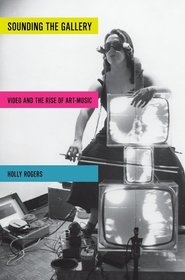
Sounding the Gallery argues that early video art is an audiovisual genre. The new video technology not only enabled artists to sound their visual work and composers to visualise their music during the 1960s: it also initiated a spatial form of engagement that encouraged new relationships between art / music practices and their audiences.
MoreLong description:
Sounding the Gallery explores the first decade of creative video work, focusing on the ways in which video technology was used to dissolve the boundaries between art and music. Becoming commercially available in the mid 1960s, video quickly became integral to the intense experimentalism of New York City's music and art scenes. The medium was able to record image and sound at the same time, which allowed composers to visualize their music and artists to sound their images in a quick and easy manner. But video not only provided artists and composers with the opportunity to produce unprecedented forms of audiovisuality; it also allowed them to create interactive spaces that questioned conventional habits of music and art consumption. Early video's audiovisual synergy could be projected, manipulated and processed live. The closed-circuit video feed drew audience members into the heart of the audiovisual experience, from where they could influence the flow, structure and sound of the video performance. Such activated spectatorship resulted in improvisatory and performative events in which the space between artists, composers, performers and visitors collapsed into a single, yet expansive, intermedial experience.
Many believed that such audiovisual video work signalled a brand-new art form that only began in 1965. Using early video work as an example, this book suggests that this is inaccurate. During the twentieth century, composers were experimenting with spatializing their sounds, while artists were attempting to include time as a creative element in their visual work. Pioneering video work allowed these two disciplines to come together, acting as a conduit that facilitated the fusion and manipulation of pre-existing elements. Shifting the focus from object to spatial process, Sounding the Gallery uses theories of intermedia, film, architecture, drama and performance practice to create an interdisciplinary history of music and art that culminates in the rise of video art-music in the late 1960s.
Sounding the Gallery stands as impressive achievement which rescues the musical dimensions of video work, whilst also convincingly and thickly arguing for its intermedial, aesthetically pioneering audiovisuality, and its performative innovation.
Table of Contents:
Introduction
1 Composing with Technology: The Artist-Composer
2 Silent Music and Static Motion: The Audio-Visual History of Video
3 Towards the Spatial: Music, Art and the Audiovisual Environment
4 The Rise of Video Art-Music: 1963-1970
5 Interactivity, Mirrored Spaces and the Closed-Circuit Feed: Performing Video
Epilogue: Towards the Twenty First Century
Index

