

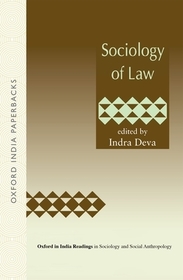
Sociology of Law
Series: Oxford in India Readings in Sociology and Social Anthropology;
- Publisher's listprice GBP 13.99
-
6 316 Ft (6 015 Ft + 5% VAT)
The price is estimated because at the time of ordering we do not know what conversion rates will apply to HUF / product currency when the book arrives. In case HUF is weaker, the price increases slightly, in case HUF is stronger, the price goes lower slightly.
- Discount 10% (cc. 632 Ft off)
- Discounted price 5 684 Ft (5 414 Ft + 5% VAT)
Subcribe now and take benefit of a favourable price.
Subscribe
6 316 Ft

Availability
Only to order.
Why don't you give exact delivery time?
Delivery time is estimated on our previous experiences. We give estimations only, because we order from outside Hungary, and the delivery time mainly depends on how quickly the publisher supplies the book. Faster or slower deliveries both happen, but we do our best to supply as quickly as possible.
Product details:
- Publisher OUP India
- Date of Publication 17 September 2009
- ISBN 9780198064459
- Binding Paperback
- No. of pages386 pages
- Size 219x140x20 mm
- Weight 419 g
- Language English 0
Categories
Short description:
Description This volume, on the sociology of law in India, analyses the relationship between the legal system and other social subsystems, law and religious identity, the societal and social rules of the judiciary in India, as well as the law and social change in India.
MoreLong description:
This collection of 21 essays analyses the relationship between legal and social systems in India, including the functioning of the legal system in tandem with other social subsystems; the legal profession; law and religious identity; law and disadvantaged groups in society; the societal and social roles of the judiciary in India; and the law and aspects of social change. Section I deals with the functioning of the law during British rule and in independent India, which also includes tribal criminal justice. Section II explores the development and social organization of the legal profession. Sections III and IV examine the association of law with religion and disadvantaged groups. Section V analyses the societal role of the judiciary with respect to public interest litigation and social action. Finally, Section VI discusses law and social change through the ages in India. In examining these diverse issues, the reader brings together the writings of eminent sociologists as well as top legal thinkers and jurists.
MoreTable of Contents:
Introduction;
Section I: Functioning of the Legal System;
Colonial Nature of the Indian Legal System (Upendra Baxi);
Administration of Hindu Law by the British (J. Duncan M. Derrett);
Law and the People (V.R. Krishna Iyer);
Patterns of Criminal Justice amongst Some Tribes (Krishna Kumar);
Law as an Instrument of Change in India (J.S. Gandhi);
Section II: The Legal Profession;
Development of the Legal Profession in India (Samuel Schmitthener);
Legal Profession and Society: A Study of Lawyers and their Clients (K.L. Sharma);
Social Organization at the District Courts: Colleague Relationships among Indian Lawyers (Charles Morrison);
Section III: Law and Religious Identity;
Religion, Law, and Secularism (Donald Eugene Smith);
Personal Laws or a Uniform Civil Code? (John H. Mansfield);
The Personal Law Question and Hindu Nationalism (Dieter Conrad);
The Shah Bano Case: Some Political Implications (Kavita R. Khory);
Section IV: Law and the Disadvantaged Groups;
Pursuing Equality in the Land of Hierarchy (Marc Galanter);
Jusprudential Foundation of Reservations (M.P. Singh);
Mandal Revisited (Ram Jethmalani);
Empowerment of Women: Legal Strategies (S.P. Sathe);
Section V: Societal Role of Judiciary;
Towards an Indian Jurisprudence of Social Action and Public Interest Litigation (V.R. Krishna Iyer);
Public Interest Litigation (Mahabaleshwar N. Morje);
Section VI: Law and Social Change;
Growth of Traditional Legal System: The Perspective of Change through the Ages (Indra Deva and Shrirama);
Law and Social Change in India (Yogendra Singh);
Constitutions and Revolutions (Peter G. Sack); Contributors; Index

