

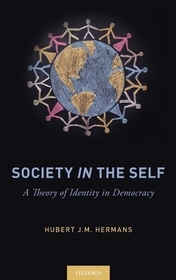
Society in the Self
A Theory of Identity in Democracy
- Publisher's listprice GBP 105.00
-
47 407 Ft (45 150 Ft + 5% VAT)
The price is estimated because at the time of ordering we do not know what conversion rates will apply to HUF / product currency when the book arrives. In case HUF is weaker, the price increases slightly, in case HUF is stronger, the price goes lower slightly.
- Discount 10% (cc. 4 740 Ft off)
- Discounted price 42 667 Ft (40 635 Ft + 5% VAT)
Subcribe now and take benefit of a favourable price.
Subscribe
47 407 Ft

Availability
printed on demand
Why don't you give exact delivery time?
Delivery time is estimated on our previous experiences. We give estimations only, because we order from outside Hungary, and the delivery time mainly depends on how quickly the publisher supplies the book. Faster or slower deliveries both happen, but we do our best to supply as quickly as possible.
Product details:
- Publisher OUP USA
- Date of Publication 26 April 2018
- ISBN 9780190687793
- Binding Hardback
- No. of pages456 pages
- Size 236x163x38 mm
- Weight 726 g
- Language English 0
Categories
Short description:
Society in the Self: A Theory of Identity in Democracy shows how society is working in the deeper regions of self and identity. This book is an exploration of the democratic potentials of self and identity in a globalizing and localizing society.
MoreLong description:
Instead of considering society as a social environment, Society in the Self begins from the assumption that society works in the deepest regions of self and identity, as expressed in phenomena like self-sabotage, self-radicalization, self-cure, self-government, self-nationalization, and self-internationalization. This leads to the central thesis that a democratic society can only function properly if it is populated by participants with a democratically organized self. In this book, an integrative model is presented that is inspired by three versions of democracy: cosmopolitan, deliberative, and agonistic democracy, with the latter focusing on the role of social power and emotions.
Drawing on these democratic views, three levels of inclusiveness are distinguished in the self: personal (I as an individual), social (I as a member of a group), and global (I as a human being). A democratic self requires the flexibility of moving up and down across these levels of inclusiveness and has to find its way in fields of tension between the self and the other, and between dialogue and social power. As author Hubert Hermans explains, this theory has far reaching consequences for such divergent topics as leadership in the self, cultural diversity in the self, the relationship between reason and emotion, self-empathy, cooperation and competition between self-parts, and the role of social power in prejudice, enemy image construction, and scapegoating.
The central message of this book is reflected in Mahatma Gandhi's dictum: "Be the change you want to see in the world."
Perhaps the most daring self-theorist working today, Hubert Hermans offers another creative gem that crosses academic boundaries and blurs traditional divisions among social and behavioral scientists. In proposing a theory of the democratic functioning of the self, Hermans takes us beyond his Dialogical Self Theory to show how a dynamic process of internal dialogue is inescapably liked to the democratic organization of society at large. Society in the Self will surely stimulate novel thinking, provoke new research, and incite fresh interpretations of the foundation of democracy itself.
Table of Contents:
Acknowledgments
Introduction: The Democratic Organization of Self and Identity
Chapter 1. The Dynamics of Society-in-the-Self
Chapter 2. Positioning and Democracy in the Self
Chapter 3. Positioning and Democracy in Teams and Organizations
Chapter 4. The Positioning Brain
Chapter 5. Social and Societal Over-Positioning: The Emergence of I-Prisons
Chapter 6. Heterogenizing and Enriching the Self
Chapter 7. Dialogue as Generative Form of Positioning
Chapter 8: Dialogical democracy in a boundary-crossing world: Practical implications
Glossary

