

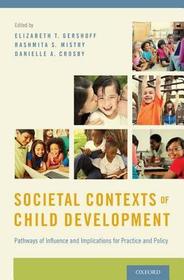
Societal Contexts of Child Development
Pathways of Influence and Implications for Practice and Policy
- Publisher's listprice GBP 82.00
-
37 023 Ft (35 260 Ft + 5% VAT)
The price is estimated because at the time of ordering we do not know what conversion rates will apply to HUF / product currency when the book arrives. In case HUF is weaker, the price increases slightly, in case HUF is stronger, the price goes lower slightly.
- Discount 10% (cc. 3 702 Ft off)
- Discounted price 33 321 Ft (31 734 Ft + 5% VAT)
Subcribe now and take benefit of a favourable price.
Subscribe
37 023 Ft

Availability
printed on demand
Why don't you give exact delivery time?
Delivery time is estimated on our previous experiences. We give estimations only, because we order from outside Hungary, and the delivery time mainly depends on how quickly the publisher supplies the book. Faster or slower deliveries both happen, but we do our best to supply as quickly as possible.
Product details:
- Edition number 1
- Publisher OUP USA
- Date of Publication 17 October 2013
- ISBN 9780199943913
- Binding Hardback
- No. of pages272 pages
- Size 160x236x22 mm
- Weight 522 g
- Language English 0
Categories
Short description:
Societal Contexts of Child Development provides comprehensive literature reviews for six broad contextual influences on children's development and addresses these contexts from an applied research perspective.
MoreLong description:
In the last half century, developmental scientists have become increasingly interested in studying contexts beyond the home environment that contribute to children's growth and development, including physical contexts such as schools and neighborhoods, as well as social contexts such as poverty. During this same period, a number of social trends have significantly impacted children's daily lives, including shifts in gender roles and expectations, the emergence of an early care and education system, and the proliferation of media technology.
Societal Contexts of Child Development provides comprehensive literature reviews for six broad contextual influences on children's development that have emerged as key areas of inquiry in contemporary society - gender, child care, culture and ethnicity, poverty, schools and neighborhoods, and media. In the spirit of applied developmental science, this book considers these six contextual domains in a series of two linked chapters written by experts in the interdisciplinary field of developmental science. The first chapter in each section is organized as a review of basic research relevant to a particular context, including a discussion of prominent theoretical and methodological issues. The second chapter in each section then addresses the same context from an applied research perspective, examining and documenting how research has been, can be, or should be used to enhance the everyday lives and developmental outcomes of children and their families through interventions and/or social policies. The book concludes with a chapter specifically dedicated to making connections between research and practice and an epilogue that situates the book's chapters within the field's study of contexts. Societal Contexts of Child Development will appeal to a broad audience of scholars, students, practitioners, and policymakers from the disciplines of psychology, sociology, economics, human development, and public policy.
I am widely recommending this excellent book.
Table of Contents:
Acknowledgments
About the Editors
Contributors
Introduction: Contextualizing Child Development
Elizabeth T. Gershoff, Rashmita S. Mistry, and Danielle A. Crosby
Section I: Gender Roles as a Restrictive Context
1. Gender Development: From Universality to Individuality
Lynn S. Liben, Rebecca S. Bigler, and Lacey J. Hilliard
2. Gender and Achievement Choices
Jacquelynne S. Eccles
Section II: Child Care: An Early Contextual Opportunity
3. Women's Work and Child Care: Perspectives and Prospects
Marion O'Brien, Jennifer M. Weaver, Margaret Burchinal, Alison Clarke-Stewart, and Deborah Lowe Vandell
4. Issues of Quality and Access Emerging from the Changing Early Childhood Policy Context: Towards the Next Generation of Research
Martha Zaslow, Danielle A. Crosby, and Nina Smith
Section III: Cultural Contexts and Immigrant Families
5. An Ecological Approach to Understanding Immigrant Child and Adolescent Developmental Competencies
Amy K. Marks, Camila Godoy, and Cynthia García Coll
6. Beyond Families and Schools: Future Directions in Practice and Policy for Children in Immigrant Families
Ana Maria Nieto and Hirokazu Yoshikawa
Section IV: Child Poverty as a Limiting Context of Development
7. Poverty and Children's Development: Familial Processes as Mediating Influences
Vonnie McLoyd, Rashmita S. Mistry, and Cecily R. Hardaway
8. The World Isn't Linear or Additive or Decontextualized: Pluralism and Mixed Methods in Understanding the Effects of Anti-Poverty Programs on Children and Parenting
Thomas S. Weisner and Greg J. Duncan
Section V: Schools and Neighborhoods: The Microcosms of Childhood
9. Neighborhood and School Contexts in the Lives of Children
Elizabeth T. Gershoff and Aprile D. Benner
10. School- and Neighborhood-Based Interventions to Improve the Lives of Disadvantaged Children
Robert Crosnoe and Tama Leventhal
Section VI: Development in the Context of Omnipresent Media
11. Children and Electronic Media
Sandra L. Calvert and Ellen A. Wartella
12. Language, Literacy and Media: What's the Word on Sesame Street?
Rosemarie T. Truglio and Jennifer A. Kotler
Section VII: Programs and Policies as Contextual Opportunities for Improving Children's Lives
13. Connecting Research and Practice
Robert C. Granger, Vivian Tseng, and Brian L. Wilcox
Epilogue: The Ecology of Human Development in the Twenty-First Century
Aletha C. Huston
Index

