

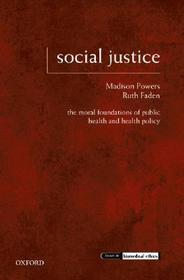
Social Justice
The Moral Foundations of Public Health and Health Policy
Series: Issues in Biomedical Ethics;
- Publisher's listprice GBP 32.50
-
15 526 Ft (14 787 Ft + 5% VAT)
The price is estimated because at the time of ordering we do not know what conversion rates will apply to HUF / product currency when the book arrives. In case HUF is weaker, the price increases slightly, in case HUF is stronger, the price goes lower slightly.
- Discount 10% (cc. 1 553 Ft off)
- Discounted price 13 974 Ft (13 308 Ft + 5% VAT)
Subcribe now and take benefit of a favourable price.
Subscribe
15 526 Ft

Availability
Out of print
Why don't you give exact delivery time?
Delivery time is estimated on our previous experiences. We give estimations only, because we order from outside Hungary, and the delivery time mainly depends on how quickly the publisher supplies the book. Faster or slower deliveries both happen, but we do our best to supply as quickly as possible.
Product details:
- Publisher Oxford University Press
- Date of Publication 27 April 2006
- ISBN 9780195189261
- Binding Hardback
- No. of pages244 pages
- Size 242x164x22 mm
- Weight 525 g
- Language English 0
Categories
Short description:
In medical ethics, discussions of justice have tended to focus on questions of inequality: how to secure equal access health care, and how to set priorities when resources are scarce. But to what extent should notions of justice inform these issues: Are all inequalities morally problematic? How important are moral concerns in setting priorities in health care and public health? How much inequality in health should we tolerate? The central issue that senior bioethicists Powers
and Faden discuss in this book is which inequalities matter most. They develop a unique theory of social justice that can cope with the specific context of health care policy, although indeed it can also be applied to education, employment opportunities, and other social problems where resources are
limited. Their approach rejects a utilitarian or distributive approach in favor of a six dimensional theory of well-being, arguing we are morally obligated to meet the needs of social groups that are least well-off in those dimensions.
Long description:
In medical ethics, discussions of justice have tended to focus on questions of inequality: how to secure equal access to health care, and how to set priorities when resources are scarce. The extent to which abstract notions of justice should inform these issues is still a fraught one however. Are all inequalities morally problematic? How important are moral concerns in setting priorities in health care and public health? How much inequality in health should we tolerate? The
central question that senior bioethicists Powers and Faden pose in this book--the first to really focus issues of justice on public health in particular--is, which inequalities matter most?LIn order to answer this question, they develop a unique theory of social justice that can cope with the specific
context of health care policy, although indeed it can also be applied to education, employment opportunities, and other social problems where resources are limited. A substantial part of the book is a useful review of the approaches to the problem, as they contrast their "social justice" approach with, among others, philosophers like Rawls and Nussbaum. Their own approach rejects a utilitarian or distributive approach in favor of a six dimensional theory of well-being, arguing that we are
morally obligated to meet the needs of social groups that are least well-off in those dimensions. The audience for the book is primarily bioethicists, but also social/political philosophers as well as anyone interested in the growing topic of justice and health care.
Table of Contents:
The Job of Justice
Justice and Well-Being
Justice, Sufficiency, and Systematic Disadvantage
Social Justice and Public Health
Medical Care and Insurance Markets
Setting Priorities
Justice, Democracy, and Social Values
Facts and Theory

