

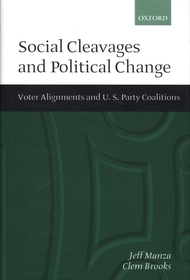
Social Cleavages and Political Change
Voter Alignments and U.S. Party Coalitions
- Publisher's listprice GBP 185.00
-
88 383 Ft (84 175 Ft + 5% VAT)
The price is estimated because at the time of ordering we do not know what conversion rates will apply to HUF / product currency when the book arrives. In case HUF is weaker, the price increases slightly, in case HUF is stronger, the price goes lower slightly.
- Discount 10% (cc. 8 838 Ft off)
- Discounted price 79 545 Ft (75 758 Ft + 5% VAT)
Subcribe now and take benefit of a favourable price.
Subscribe
88 383 Ft

Availability
printed on demand
Why don't you give exact delivery time?
Delivery time is estimated on our previous experiences. We give estimations only, because we order from outside Hungary, and the delivery time mainly depends on how quickly the publisher supplies the book. Faster or slower deliveries both happen, but we do our best to supply as quickly as possible.
Product details:
- Publisher OUP Oxford
- Date of Publication 23 September 1999
- ISBN 9780198294924
- Binding Hardback
- No. of pages354 pages
- Size 242x162x24 mm
- Weight 663 g
- Language English
- Illustrations tables and graphs 0
Categories
Short description:
The book examines the changing nature of social cleavages and their effect on political allegiances and voting behaviour in the United States since the 1950s.
MoreLong description:
What social groups support which political party, and how that support has changed over time, are central questions in the sociology of political behaviour. This study provides the first systematic book-length reassessment and restatement of the sociological approach to American politics in more than 20 years. It challenges widespread arguments that the importance of social cleavages have declined precipitously in recent years in the face of post-industrial social and economic changes.
The book reconceptualizes the concept of social cleavages and focus on four major cleavages in American society: class, religion, gender, and race, arguing a that a number of important changes in the alignments of the groups making up these four cleavages have occurred.
The book examines the implications of these changes for the Democratic and Republican Parties. The findings of the book are examined in light of the central dilemmas facing the two major parties in the contemporary political environment.
This is a wonderful book that no one interested in U.S. voting behaviour and presidential elections should ignore.
Table of Contents:
Introduction
The Sociological Tradition in Political Behaviour Research
Social Cleavages and American Politics
Class
Religion
Gender
Race and the Social Bases of Voter Alignments
Party Coalitions
Social Cleavages in the 1996 Elections
Third Party Candidates
Conclusion

