

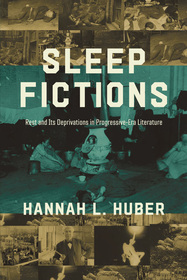
Sleep Fictions
Rest and Its Deprivations in Progressive-Era Literature
Series: Topics in the Digital Humanities;
- Publisher's listprice GBP 88.00
-
42 042 Ft (40 040 Ft + 5% VAT)
The price is estimated because at the time of ordering we do not know what conversion rates will apply to HUF / product currency when the book arrives. In case HUF is weaker, the price increases slightly, in case HUF is stronger, the price goes lower slightly.
- Discount 10% (cc. 4 204 Ft off)
- Discounted price 37 838 Ft (36 036 Ft + 5% VAT)
Subcribe now and take benefit of a favourable price.
Subscribe
42 042 Ft

Availability
Estimated delivery time: In stock at the publisher, but not at Prospero's office. Delivery time approx. 3-5 weeks.
Not in stock at Prospero.
Why don't you give exact delivery time?
Delivery time is estimated on our previous experiences. We give estimations only, because we order from outside Hungary, and the delivery time mainly depends on how quickly the publisher supplies the book. Faster or slower deliveries both happen, but we do our best to supply as quickly as possible.
Product details:
- Edition number 1
- Publisher University of Illinois Press
- Date of Publication 21 November 2023
- Number of Volumes Hardback
- ISBN 9780252045400
- Binding Hardback
- No. of pages200 pages
- Size 229x152 mm
- Weight 454 g
- Language English
- Illustrations 16 color photographs 464
Categories
Short description:
A turn-of-the-century influx of new technologies and the enormous impact of the electric light transformed not only individual sleeping habits but the ways American culture conceived and valued sleep. Huber analyzes the works of Henry James, Edith Wharton, Charles Chesnutt, and Charlotte Perkins Gilman to examine the literary response to the periodâ€TMs obsession with wakefulness.
MoreLong description:
"The literary response to the dawning cult of wakefulness
A turn-of-the-century influx of new technologies and the enormous impact of the electric light transformed not only individual sleeping habits but the ways American culture conceived and valued sleep. Hannah L. Huber analyzes the works of Henry James, Edith Wharton, Charles Chesnutt, and Charlotte Perkins Gilman to examine the literary response to the period’s obsession with wakefulness. As these writers blurred the separation of public and private space, their characters faced exhaustion in a modern world that permeated every moment of their lives with artificial light, traffic noise, and the social pressure to remain active at all hours. The implacable cultural clock and constant stress over physical limitations had an even greater impact on marginalized figures. Huber pays particular attention to how these writers rebutted Americans’ confidence in the body’s ability to conquer sleep with vivid portraits of the devastating consequences of sleep disruption and deprivation.
The author also provides a website and text visualization tool that offers readers an interdisciplinary, deconstructed analysis of the book’s primary texts. The website can be found at: https://sleepfictions.org/sleep/scalar/index
" MoreTable of Contents:
Acknowledgements
Introduction   From Mystery to Medicine: Diagnosing Sleep in American Literature
- “The Most Restless of Mortals”: Patronage and Somnambulism in Henry James’s Roderick Hudson
- “A Monst’us Pow’ful Sleeper”: Resisting the Master Clock in Charles Chesnutt’s “Uncle Julius” Tales
- “A Great Blaze of Electric Light”: Illuminating Sleeplessness in Edith Wharton’s The House of Mirth
- “Rest and Power”: The Social Currency of Sleep in Charlotte Perkins Gilman’s Forerunner
Notes
References
Index
More
