

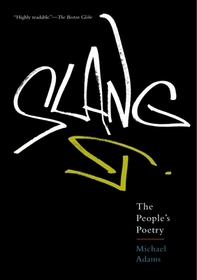
Slang
The People's Poetry
- Publisher's listprice GBP 21.99
-
9 928 Ft (9 455 Ft + 5% VAT)
The price is estimated because at the time of ordering we do not know what conversion rates will apply to HUF / product currency when the book arrives. In case HUF is weaker, the price increases slightly, in case HUF is stronger, the price goes lower slightly.
- Discount 10% (cc. 993 Ft off)
- Discounted price 8 935 Ft (8 510 Ft + 5% VAT)
Subcribe now and take benefit of a favourable price.
Subscribe
9 928 Ft

Availability
printed on demand
Why don't you give exact delivery time?
Delivery time is estimated on our previous experiences. We give estimations only, because we order from outside Hungary, and the delivery time mainly depends on how quickly the publisher supplies the book. Faster or slower deliveries both happen, but we do our best to supply as quickly as possible.
Product details:
- Publisher OUP USA
- Date of Publication 27 September 2012
- ISBN 9780199913770
- Binding Paperback
- No. of pages256 pages
- Size 216x142x7 mm
- Weight 272 g
- Language English 0
Categories
Short description:
In Slang: The People's Poetry, Michael Adams covers this perennially interesting subject in a serious but highly engaging way, illuminating the fundamental question "What is Slang? " and defending slang--and all forms of nonstandard English--as integral parts of the American language.
MoreLong description:
Slang, writes Michael Adams, is poetry on the down low, and sometimes lowdown poetry on the down low, but rarely, if ever, merely lowdown. It is the poetry of everyday speech, the people's poetry, and it deserves attention as language playing on the cusp of art.
In Slang: The People's Poetry, Adams covers this perennially interesting subject in a serious but highly engaging way, illuminating the fundamental question "What is Slang?" and defending slang--and all forms of nonstandard English--as integral parts of the American language. Why is an expression like "bed head" lost in a lexical limbo, found neither in slang nor standard dictionaries? Why are snow-boarding terms such as "fakie," "goofy foot," "ollie" and "nollie" not considered slang? As he addresses these and other lexical curiosities, Adams reveals that slang is used in part to define groups, distinguishing those who are "down with it" from those who are "out of it." Slang is also a rebellion against the mainstream. It often irritates those who color within the lines--indeed, slang is meant to irritate, sometimes even to shock. But slang is also inventive language, both fun to make and fun to use. Rather than complain about slang as "bad" language, Adams urges us to celebrate slang's playful resistance to the commonplace and to see it as the expression of an innate human capacity, not only for language, but for poetry.
Table of Contents:
Preface
1. "What it is?"
2. Fitting In
3. Standing Out
4. It's All in Your Head
Index

