

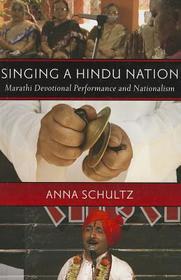
Singing a Hindu Nation
Marathi Devotional Performance and Nationalism
- Publisher's listprice GBP 117.50
-
53 051 Ft (50 525 Ft + 5% VAT)
The price is estimated because at the time of ordering we do not know what conversion rates will apply to HUF / product currency when the book arrives. In case HUF is weaker, the price increases slightly, in case HUF is stronger, the price goes lower slightly.
- Discount 10% (cc. 5 305 Ft off)
- Discounted price 47 746 Ft (45 473 Ft + 5% VAT)
Subcribe now and take benefit of a favourable price.
Subscribe
53 051 Ft

Availability
printed on demand
Why don't you give exact delivery time?
Delivery time is estimated on our previous experiences. We give estimations only, because we order from outside Hungary, and the delivery time mainly depends on how quickly the publisher supplies the book. Faster or slower deliveries both happen, but we do our best to supply as quickly as possible.
Product details:
- Publisher OUP USA
- Date of Publication 10 January 2013
- ISBN 9780199730827
- Binding Hardback
- No. of pages256 pages
- Size 160x236x17 mm
- Weight 474 g
- Language English
- Illustrations 37 illustrations 0
Categories
Short description:
Singing a Hindu Nation is a study of rāgs>rīya kīrtan, a western Indian performance medium that combines song, Hindu philosophical discourse, and nationalist storytelling. Author Anna Schultz demonstrates how, through this particular form of musical performance, the political becomes devotional, and explores why it motivates people to action and violence.
MoreLong description:
Singing a Hindu Nation is a study of rāgs>rīya kīrtan, a western Indian performance medium that combines song, Hindu philosophical discourse, and nationalist storytelling. Beginning during the anti-colonial movement of the late nineteenth-century, performers of rāgs>rīya kīrtan led masses of Marathi-speaking people in temples and streets, and they have continued to preach and sing nationalism as devotion in the post-colonial era, and into the twenty-first century. In this book, author Anna Schultz demonstrates how, through this particular form of musical performance, the political becomes devotional, and explores why it motivates people to action and violence. Through both historical and ethnographic studies, Schultz shows that rāgs>rīya kīrtan has been especially successful in combining these two realms because kīrtankārs perform as representatives of the divine sage Narad, thereby infusing their nationalist messages with ritual weight. By speaking and singing in regional idioms with rich associations for Maharashtrian congregations, they use music to combine political and religious signs in ways that seem natural and desirable, promoting embodied experiences of nationalist devotion. As the first monograph on music and Hindu-nationalism, Singing a Hindu Nation presents a rare glimpse into the lives and performance worlds of nationalists on the margins of all-India political parties and cultural organizations, and is an essential resource for ethnomusicologists, as well as scholars of South Asian studies, religion, and political theory.
Elegantly crafted, Singing a Hindu Nation is a historically grounded ethnography of the kirtan genre of singing and storytelling in Maharashtra, India. Exploring a spectrum of devotional performances, Schultz demonstrates the potency of kirtan in animating traditional aesthetic categories and manipulating public opinion. This timely work not only reveals a lesser known facet of Hindu nationalism, it contributes significantly to the growing body of scholarship delineating music's critical role in a variety of Indian modernist projects.
Table of Contents:
Acknowledgements
Notes on Transliteration and Orthography
About the Companion Website
1. Introduction. Standing on Nàrad's Mat: Nationalism and
Hindu Performance in Western India
PART I: Marathi Kãrtan and Modernity Before 1947
2. Nàradãya Kãrtan for "Modern Educated People"
3. Ràùñrãya Kãrtan: Resisting Modernity, Devotionalizing Nationalism
PART II: Nationalist Kãrtan Within and Beyond the Post-Colonial State
4. "From 'Home Rule' to 'Good Rule'": Nationalism and Kãrtan After Independence
5. The Re-Institutionalization of Marathi Kãrtan: Hindutva Networks and Gender
PART III: Performing a Hindu Nation
6. Performance, Genre, and Politics in Ràùñrãya Kãrtan
7: Sudhatai Dhamankar: Embedded Embodiments
8. Yogeshwar Upasani: The Collision of Genres and Collusion of Participants
9. Conclusion
References
Glossary

