
• Contact

  • Newsletter

  • About us

  • Delivery options

  • Prospero Book Market Podcast

  • Sight Singing Complete

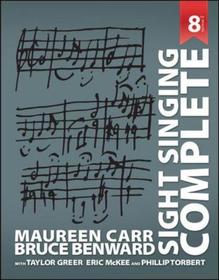
    Sight Singing Complete by Carr, Maureen A; Benward, Bruce;

      • GET 10% OFF

      • The discount is only available for 'Alert of Favourite Topics' newsletter recipients.
      • Publisher's listprice GBP 89.99
      • The price is estimated because at the time of ordering we do not know what conversion rates will apply to HUF / product currency when the book arrives. In case HUF is weaker, the price increases slightly, in case HUF is stronger, the price goes lower slightly.

        42 992 Ft (40 945 Ft + 5% VAT)
      • Discount 10% (cc. 4 299 Ft off)
      • Discounted price 38 693 Ft (36 851 Ft + 5% VAT)

    42 992 Ft

    Availability

    Uncertain availability. Please turn to our customer service.

    Why don't you give exact delivery time?

    Delivery time is estimated on our previous experiences. We give estimations only, because we order from outside Hungary, and the delivery time mainly depends on how quickly the publisher supplies the book. Faster or slower deliveries both happen, but we do our best to supply as quickly as possible.

    Product details:

    • Edition number 8
    • Publisher McGraw-Hill Higher Education
    • Date of Publication 1 February 2014

    • ISBN 9780073526652
    • Binding Spiral bound
    • No. of pages368 pages
    • Size 276x226x15 mm
    • Weight 794 g
    • Language English
    • 0

    Categories

    Table of Contents:

    Unit 1

    A. Rhythm—Simple Meter: One-, Two-, and Three-Beat Values and Duple Division of the Beat

    B. Diatonic Models and Melodic Fragments:M2 and m2

    C. Melodies by Bruce Benard(Major):M2 and m2

    D. Melodies

    E. Ensembles and Play + Sing

    Unit 2

    A. Rhythm—Compound Meter

    B. Diatonic Models and Melodic Fragments: P5, P4, M3, m3, M2, and m2

    C. Melodies (Major): P5, P4, M3, and m3 within the Tonic Triad and M2 and m2

    D. Melodies (Major): P5, P4, M3, and m3 within the Diatonic Scale

    E. Ensembles and Play + Sing

    Unit 3

    A. Rhythm—Simple Meter: Duple Division of the Beat

    B. Diatonic Models and Melodic Fragments for Interval Singing: P8, P5, P4, M3, m3, M2, and m2

    C. Melodies (Major): P5, P4, M3, m3, M2 and m2 with the Diatonic Scale

    D. Melodies (Minor): Mostly by Bruce Benward

    E. Ensembles and Play + Sing

    Unit 4

    A. Rhythm—Simple Meter: Quadruple Subdivision of the Beat

    B. Diatonic Models and Melodic Fragments: m10, P8, P5, P4, M3, m3, M2, and m2

    C. Melodies (Major and Minor): P5, P4, M3, m3, M2, and m2

    D. Melodies (Major and Minor): P5, P4, M3, m3, M2, and m2

    E. Ensembles and Play + Sing

    Unit 5

    A. Rhythm—Simple Meter with the Triplets

    B. Diatonic Models and Melodic Fragments: M6 and m6

    C. Melodies (Major and Minor): M6 and m6

    D. Melodies (Major and Minor): M6 and m6

    E. Ensembles and Play + Sing

    Unit 6

    A. Rhythm—Simple Meter: Further Subdivision of the Beat in Simple Meter

    B. Diatonic Models and Melodic Fragments: M6 and m6

    C. Melodies (Major and Minor): M6 and m6

    D. Melodies (Major and Minor): M6 and m6

    E. Ensembles and Play + Sing

    Unit 7

    A. Rhythm—Hemiola

    B. Diatonic Models and Melodic Fragments: M7

    C. Melodies (Major and Minor: M6 and m6

    D. Melodies (Major and Minor): M6 and m6

    E. Ensembles and Play + Sing

    Unit 8

    A. Rhythm-Simple Meter:The Supertriplet

    B. Diatonic Models and Melodic Fragments:m7 and M7

    C. Melodies (Major and Minor): m7

    D. Melodies (Major and Minor): m7

    E. Ensembles and Play + Sing

    Unit 9

    A. Rhythm—Further Subdivisions of the Beat in Compound Meter and 3 against 2

    B. Diatonic Models and Melodic Fragments: A4 and d5

    C. Melodies (Major and Minor): Chromatic Alterations, Modulating and Nonmodulating

    D. Melodies (Major and Minor): Chromatic Alterations, Modulating and Nonmodulating

    E. Ensembles and Play + Sing

    Unit 10

    A. Rhythm—Changing Meter with Triplets and Aligned and Displaced Hemiolas

    B. Diatonic and Chromatic Models and Melodic Fragments: A4 and d5

    C. Melodies with Chromatic Alterations

    D. Melodies with Chromatic Alterations

    E. Ensembles and Play + Sing

    Unit 11

    A. Rhythm—Subdivisions of the Beat into eight parts

    B. Diatonic and Chromatic Models and Melodic Fragments: d7 and A2

    C. Melodies with Modal Characteristics

    D. More Melodies

    E. Ensembles and Play + Sing

    Unit 12

    A. Rhythm—The Quartolet

    B. Chromatic Models and Melodic Fragments: A6 and d3

    C. Melodies with Modal Characteristics

    D. Melodies

    E. Ensembles and Play + Sing

    Unit 13

    A. Rhythm—Further Subdivisons of the Beat:4 against 3

    B. Diatonic and Chromatic Models and Melodic Fragments: d4

    C. Melodies Related to Jazz

    D. Melodies by Duke Ellington

    E. Ensembles and Play + Sing

    Unit 14

    A. Rhythm—Irregular of Additive Meter

    B. Modal Mixtures and Enharmonic Modulation Models and Melodic Fragments

    C. Twentieth-Century Cabaret Songs by Arnold Schoenberg

    D. Twentieth-Century Songs

    E. Ensembles and Play + Sing

    Unit 15

    A. Rhythm—Changing Meterswith Constant Pulse

    B. Whole-Tone, Octatonic, and Atonal Models and Melodic Fragments:All Intervals

    C. Twentieth-Century Melodies

    D. Vocalises by Honegger and Martinu

    E. Ensembles of the Twentieth Century

    Unit 16

    A. Rhythm—Polymeter

    B. Twelve-Tone Models and Melodic Fragments for Interval Study

    C and D. Twentieth-Century Melodies

    E. Ensembles of the Twentieth Century

    More

    0