

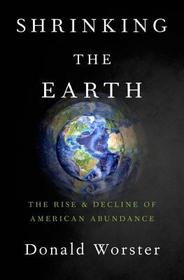
Shrinking the Earth
The Rise and Decline of American Abundance
- Publisher's listprice GBP 26.49
-
11 960 Ft (11 390 Ft + 5% VAT)
The price is estimated because at the time of ordering we do not know what conversion rates will apply to HUF / product currency when the book arrives. In case HUF is weaker, the price increases slightly, in case HUF is stronger, the price goes lower slightly.
- Discount 10% (cc. 1 196 Ft off)
- Discounted price 10 764 Ft (10 251 Ft + 5% VAT)
Subcribe now and take benefit of a favourable price.
Subscribe
11 960 Ft

Availability
printed on demand
Why don't you give exact delivery time?
Delivery time is estimated on our previous experiences. We give estimations only, because we order from outside Hungary, and the delivery time mainly depends on how quickly the publisher supplies the book. Faster or slower deliveries both happen, but we do our best to supply as quickly as possible.
Product details:
- Publisher OUP USA
- Date of Publication 18 February 2016
- ISBN 9780199844951
- Binding Hardback
- No. of pages280 pages
- Size 163x234x27 mm
- Weight 576 g
- Language English
- Illustrations 20 halftones 0
Categories
Short description:
Donald Worster engages with key political, economic, and environmental thinkers while presenting his own interpretation of the role of capitalism and government in issues of wealth, abundance, and scarcity.
MoreLong description:
The discovery of the Americas around 1500 AD was an extraordinary watershed in human experience. It gave rise to the modern period of human ecology, a phenomenon global in scope that set in motion profound changes in almost every society on earth. This new period, which saw the depletion of the lands of the New World, proved tragic for some, triumphant for others, and powerfully affecting for all.
In this work, acclaimed environmental historian Donald Worster takes a global view in his examination of the ways in which complex issues of worldwide abundance and scarcity have shaped American society and behavior over three centuries. Looking at the limits nature imposes on human ambitions, he questions whether today's America is in the midst of a shift from a culture of abundance to a culture of limits-and whether American consumption has become reliant on the global South. Worster engages with key political, economic, and environmental thinkers while presenting his own interpretation of the role of capitalism and government in issues of wealth, abundance, and scarcity. Acknowledging the earth's agency throughout human history, Shrinking the Earth offers a compelling explanation of how we have arrived where we are today and a hopeful way forward on a planet that is no longer as large as it once was.
[R]emarkable. ... [A] brilliantly crafted discussion of the limits imposed by our natural reserves, combining historical analysis, economic development and political decision making. Worster has the rare ability to present complex ideas in an easily accessible manner. He fills his book with the stories of the people who brought us both riches as a society and a body of ideas we can use to make us healthy again.
Table of Contents:
Prologue: Gatsby's Green Light
Part One: Second Earth
The Age of Abundance Begins
Many Revolutions Follow
Ultimately, Stability
Field Trip: Nantucket Island
Part Two: After the Frontier
The Watershed
Land of Coal and Steel
The Resourceful State
Field Trip: Imperial Valley
Part Three: Planet of Limits
Plunder and Plenty
David Potter's America
A Wolf over the Hill
Earth's Boundaries
Field Trip: Athabasca River
Epilogue: Life on a Pale Blue Dot
Notes
Acknowledgments
Index

